

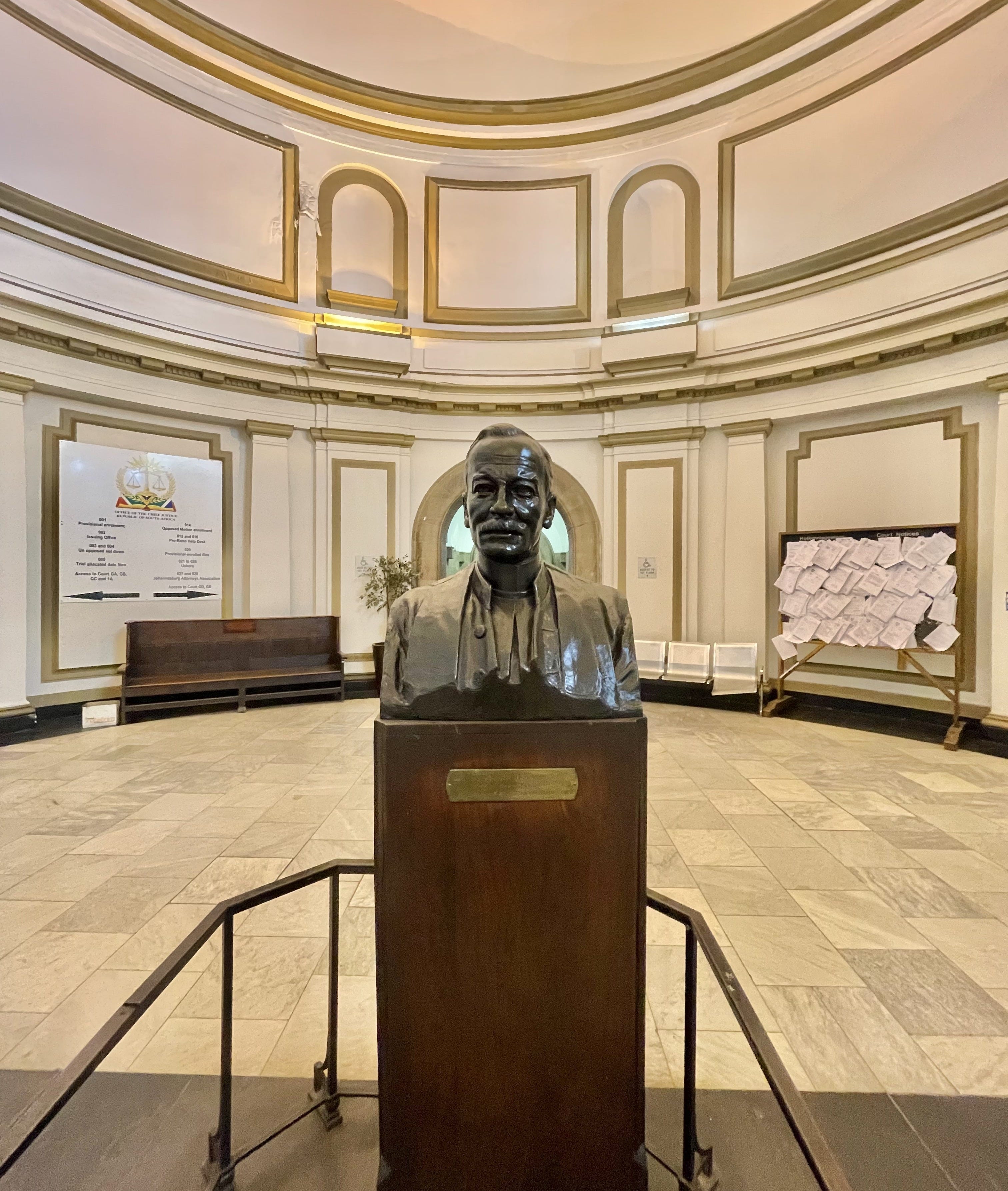
During court term, hundreds of lawyers and members of the public move through the foyer of the Johannesburg High Court daily. The building processes litigation in bulk with unopposed motions on the ground floor, opposed motions and trials rising through the storeys above, many hundreds of matters often heard on any single day. Every one of those practitioners, moving in and out, circles the same fixed point: a bronze bust of a man, guarded by railings, mostly unremarked and unexplained.
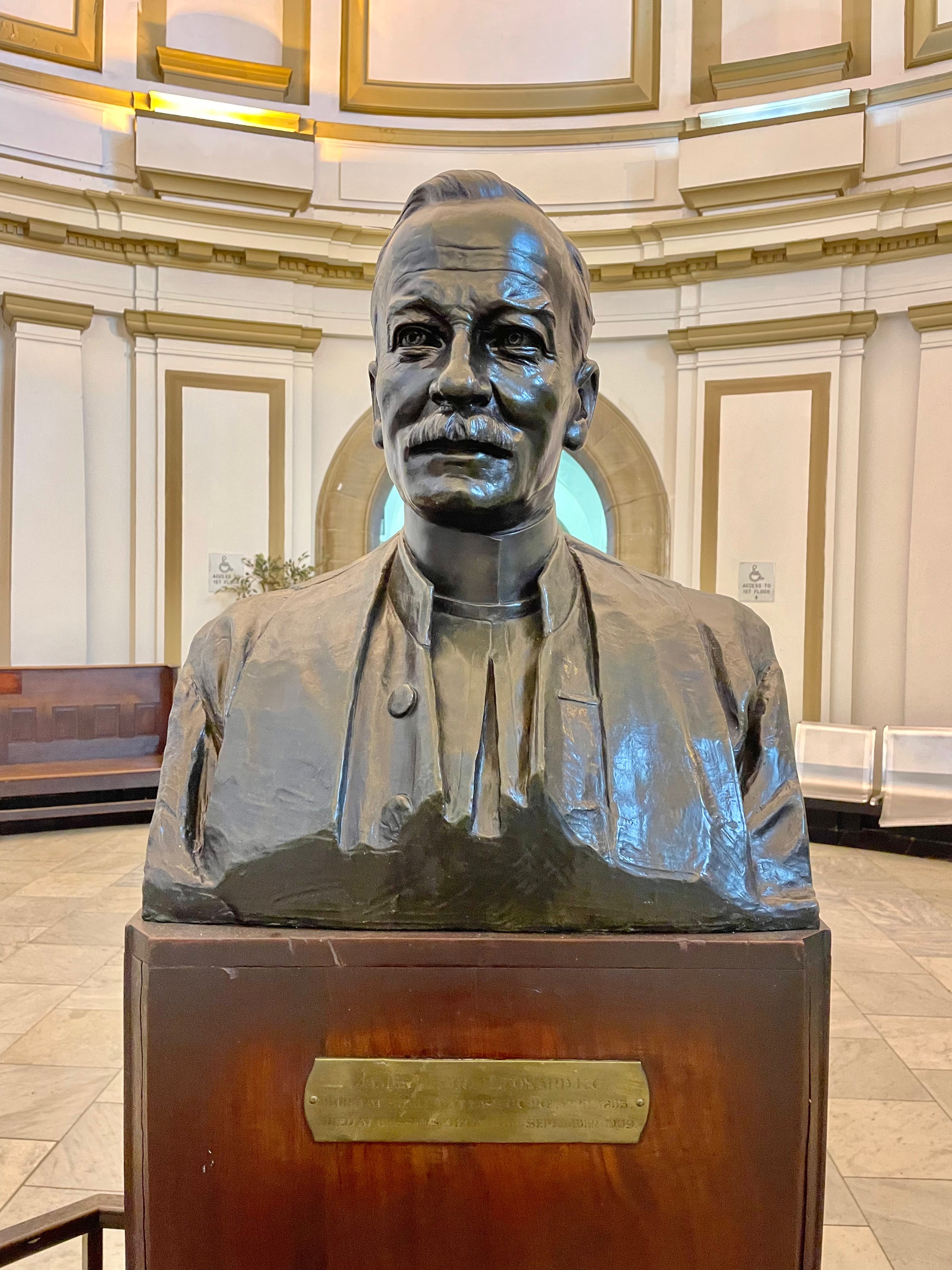
Nobody really pays him much notice. Some might stop for a moment and give the sculpture a quick look. But it is not contextualised by any descriptive signage. He is just there, inherited. I don’t know since when, but it looks like he’s been there a while.1
The Johannesburg High Court is mostly hollowed out when it comes to art and judicial portraits. Unlike more superior courts, i.e. the Constitutional Court and the Supreme Court of Appeal, which make deliberate use of art and symbolism in their various spaces, this court’s walls are mostly empty, barring an odd picture or portrait row scattered throughout. The enchantment of law is lesser for it.
The Johannesburg Magistrates’ Court has Pierneef paintings on its walls. That’s serious art giving some gravity to the building. But the Johannesburg High Court is almost bare, apart from the gentleman in the foyer whose nameplate is now almost illegible.
The contrast with Pretoria is instructive. In the Palace of Justice, there are busts of Judge President BM Ngoepe and retired Judge President CF Eloff, by sculptor Herman McDonald, added to fashion the Pretoria court’s post-apartheid, democratic image.2 In the more contemporary High Court building across the street, judicial images show transformation happening as you descend — the many chambers portraits become progressively more diverse in the lower, more recent timeline, while higher up they revert to an unbroken line of white men. The judicial tea room there once held only portraits of white judges; that room has since been changed, I’m told.
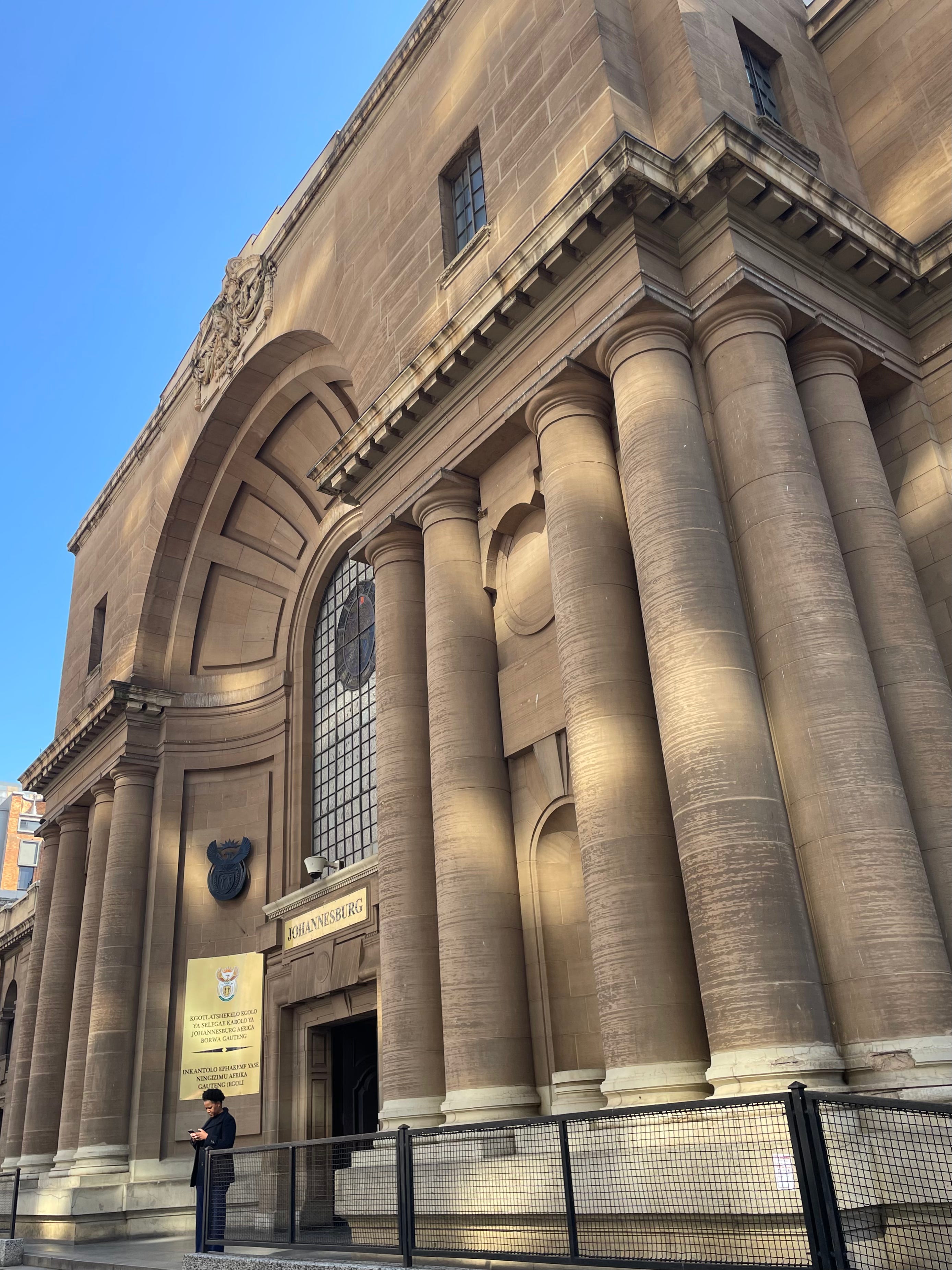
The building itself
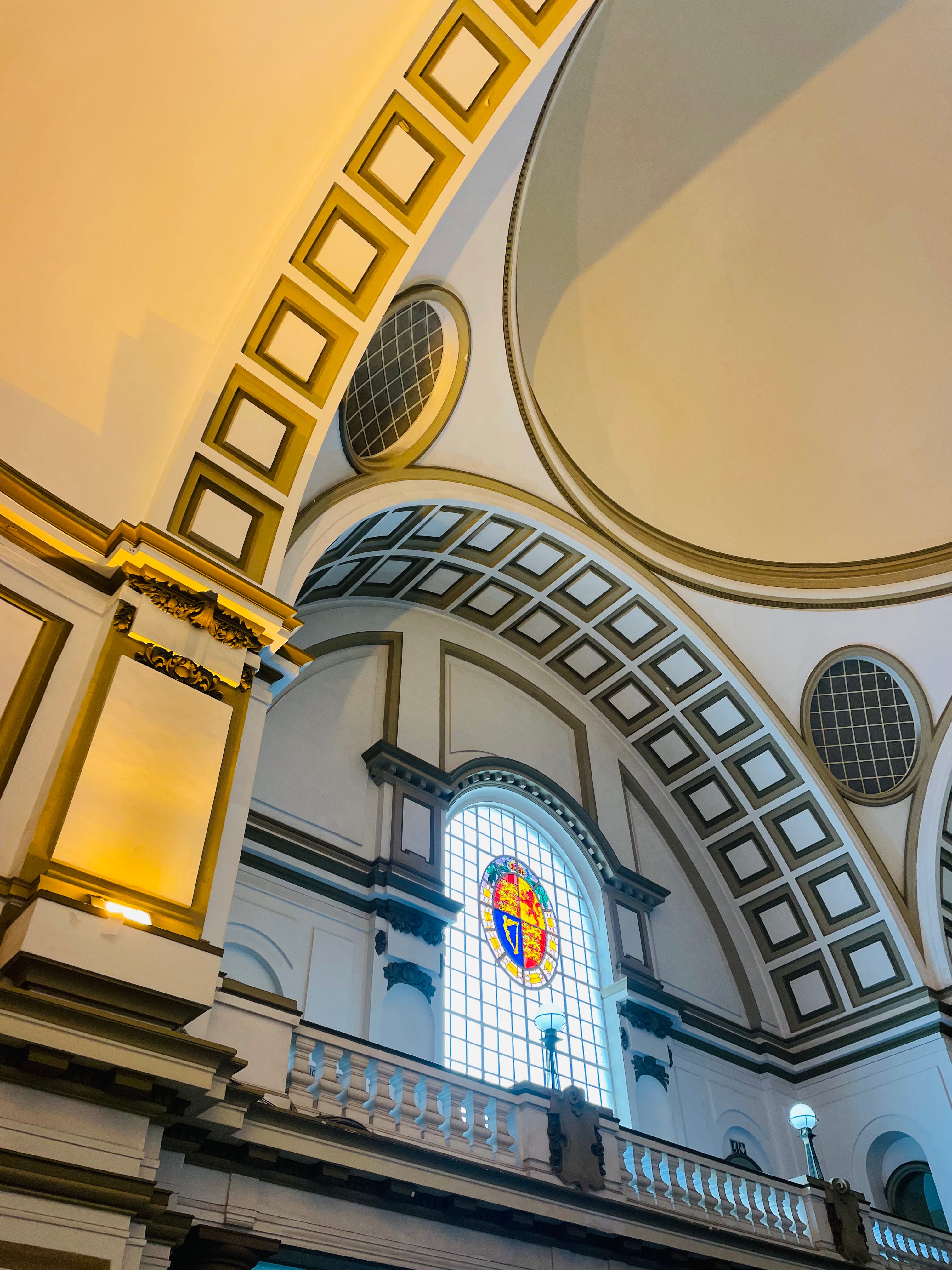
Before I get to identifying the man and what he symbolically represents, some context within which he stands, drawn from Dirk R van Zyl’s piece in Advocate3 of April 2010. The Johannesburg High Court was created by the same 1902 proclamation that established what is now the Pretoria seat, and was known first as the Witwatersrand District Court. Although the opening of the court was anticipated for 20 May 1902, the building itself was only inaugurated in 1910, the same year the Transvaal Colony ceased when the Union of South Africa was formed. It was designed by the architect Gordon Leith, at a time when Lord Milner wanted buildings across post-war Johannesburg to express the supremacy of the British Empire and the order and rationale of Victorian ‘enlightenment’. Above the entrance, a stained-glass coat of arms of the Transvaal Colony (1902–1910) survives — apparently the only one of its kind left in Johannesburg, the Rissik Street Post Office having carried the other example until it burned down in 2009.
Outside, on the building’s south-western corner, stands a statue of Carl von Brandis — commemorating a man who was not a judge, but a special landdrost of the Witwatersrand under whom the young mining camp’s disputes were once settled.
On to the Leonard bust.
James Weston Leonard
The man at the centre of all this commotion.
James Weston Leonard K.C. was born in Somerset East in the Cape Colony on 20 April 1853, and died in Brussels on 3 September 1909, after a long struggle with cancer.4 He was educated at Gill College in Somerset East, in the company of, among others, Richard and William Solomon; James Rose-Innes and W.P. Schreiner were pupils there not long after him. He read law at the now University of Cape Town, graduating with an LLB in 1876, and was called to the Cape Bar in the same year.
His career was considerable. At the age of eighteen he set out for opportunity to the newly discovered diamond fields at Kimberley. In the following year, 1872, he joined the staff of a newspaper in the Karoo, the Richmond Era. He was soon promoted to editor and held the position for three years, ultimately becoming the newspaper's proprietor. But this was not his only vocation during that time. At the end of 1876, Leonard was admitted to the Bar of the Supreme Court of Cape Colony. He sat in the Cape Legislative Assembly as member for Oudtshoorn from 1879 to 1888, and served twice as Attorney-General of the Cape Colony — first briefly in 1881, then from 1882 to 1884. He took silk in 1883, at the age of thirty.
The obituary to Leonard appearing in the South African Law Journal (cited above) includes an extract of his oratory from an 1884 speech to a public meeting at the Commercial Exchange in Cape Town, called to protest Transvaal encroachment into Bechuanaland — a speech remembered, and reprinted there, as an assertion of British supremacy in South Africa.
After the discovery of gold, Leonard moved to Johannesburg in 1888 and quickly became the leading advocate at the young Johannesburg Bar. He was a prominent champion of the ‘uitlanders’ (British) cause against the Kruger government, and was a member of the Reform Committee at the time of the Jameson Raid of 1895–96. He was imprisoned by the Kruger government in Pretoria gaol along with fifty-eight other Johannesburg men implicated in the Raid, and was released only on payment of a substantial fine and an undertaking to stay out of politics for two years.
He later qualified at the English Bar, practising in London intermittently between 1897 and 1902, before returning to Johannesburg, where he reportedly built one of the most lucrative practices in the country. He avoided standing again for elected office, though his sympathies remained with the Progressive Party of the Cape Colony, which supported pro-imperialist policies.
His Law Journal obituary records his rhetorical gift. He is described as a ‘silver-tongued’ man whose eloquence and persuasiveness were what the bench itself chose to eulogise. The University of Witwatersrand used funds from a Leonard Memorial Fund from 1921 to establish the Leonard Memorial Law Library in his name, which grew to a collection of over 2,000 volumes that was, in the end, destroyed entirely in the fire that gutted Wits’s Central Block on 24 December 1931.5
Ok, what’s next
Interesting man, this Leonard. A gifted and influential mover and shaker, and imperial loyalist. Rich silk at 30. But still as relevant as his central placement in the country’s busiest court suggests?
As a symbol, for those who do not know his history, he might stand as a figurehead and reminder of the oppressive legal past. Having come to learn about his life, I hardly feel he planted seeds for achieving a more just society, but was perceived as an aspirational figure of success in the city. He impressed his peers.
As we move toward achieving the ideals of our democratic constitutional order, this sculpture seems to contribute little or nothing to advancing those ideals.
I’m not suggesting what should replace the sculpture, or whether it should be moved rather than removed, recontextualised rather than erased. But I don’t think, having gone through what can be said about him, that James Weston Leonard’s presence in that foyer can be treated as nothing to bother about. It might be time we looked at him properly and asked why it is he who still stands there.
Liked this? See more of my pieces on the aesthetics of law.
About the author and publication
I’ve seen been informed by art historian Gerard de Kamper that the sculpture was commissioned in 1911, and created by artist Anton van Wouw. It is likely that the sculpture then was installed shortly after the court building’s opening in 1910.
Henk Havenga, ‘Pretoria Bar taking the lead’ Advocate, April 2007
Dirk R van Zyl, ‘More on the South Gauteng High Court’ Advocate, April 2010
‘The Late James W. Leonard, K.C.’ South African Law Journal, vol. 27, no. 1, 1910, pp. 1-11. HeinOnline. Wikipedia, ‘James Weston Leonard’.
Ellison Kahn, ‘The Wits Faculty of Law 1922–1989: A Story with a Personal Touch’, Consultus, October 1989
What a treat, this piece of research. The question I'm left with is the gap you point to almost in passing: nobody seems to know when or why the bust was placed there. The timing is suggestive - Leonard died in 1909, the building was inaugurated in 1910, and there was clearly memorial money about (the Wits library fund). Was he installed at the opening as a founding statement about whose court this was, or did he drift in later through institutional inertia? It seems to matter for the "what next" question because a deliberate founding gesture makes a stronger case for recontextualisation than an accident of storage. Do the Bar council minutes or court records say anything, or does the trail run cold?