

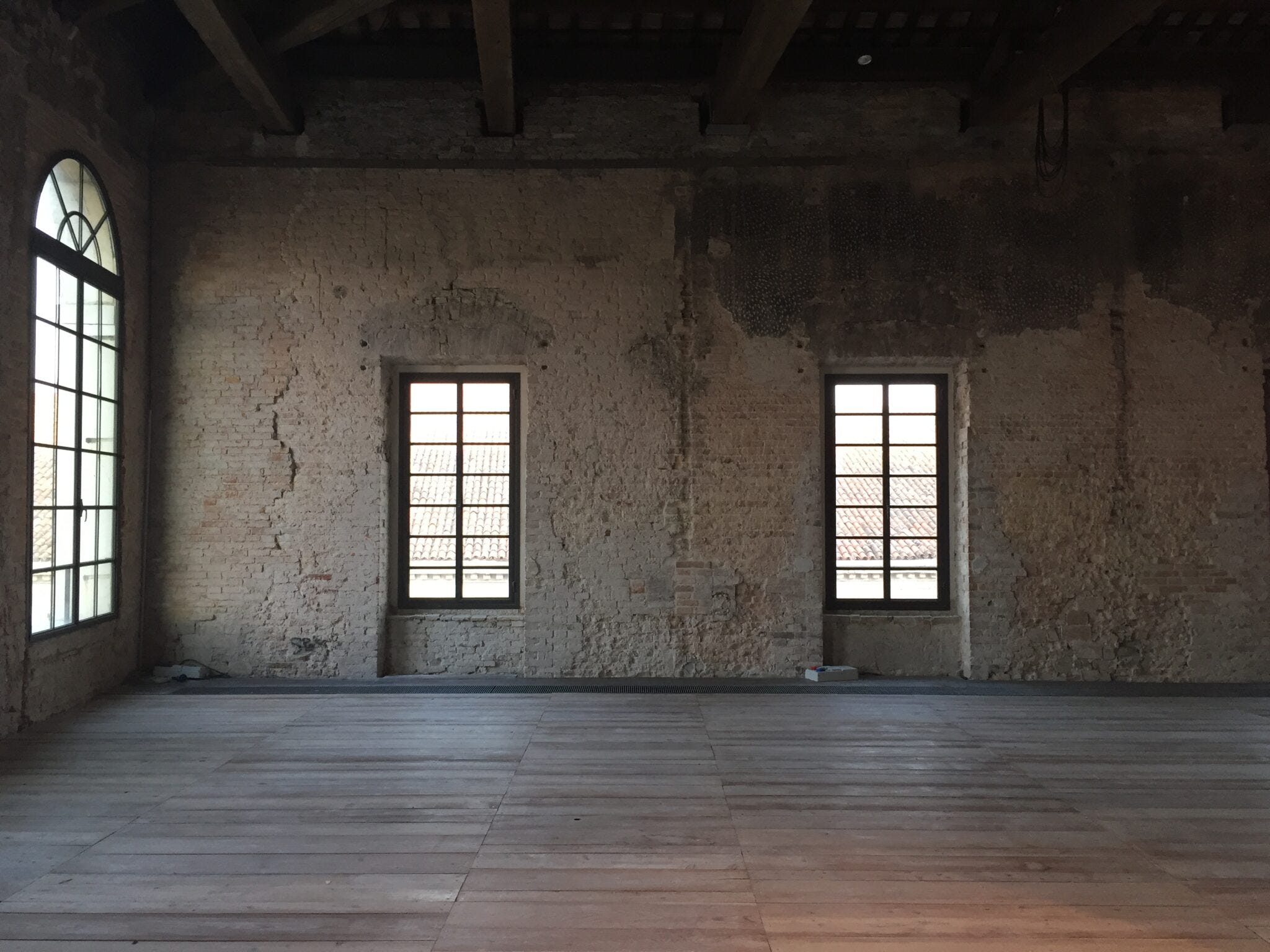
The Venice Biennale is not an art show. Or rather, it is not only an art show. Established in 1895 and held biennially in the canals and former shipyards of Venice, it is one of the oldest and most prestigious international cultural events in the world — but to describe it merely as a showcase for contemporary art is to miss its deeper function entirely. The Biennale is a theatre of nations. Its pavilions — some owned outright by established states in the historic Giardini, others rented by newer and Global South participants in the Arsenale (which is in and of itself indicative of its politics) — are, in the words of scholar Eliza Garnsey, “proxies through which states present an image of themselves to the international community.” In her monograph The Justice of Visual Art (2019, Cambridge University Press), based on extensive fieldwork at both the South African Constitutional Court and the South African Pavilion at Venice, Garnsey argues that the Biennale’s spatial and geopolitical architecture forces comparisons between states. The Biennale, she demonstrates, is fertile ground for states to offer competing visions of themselves, their values, and their place in the international order. Individual curators and artists also get space to challenge, in turn, those nations present and absent. Art, in this context, becomes — as Garnsey puts it — a radical form of political participation. The head of the British pavilion once put the point more bluntly: “I hate to employ the word using, but our job is to use art to serve Britain’s foreign policy objectives overseas.”1 Nations arrive at Venice not merely to exhibit. They arrive to be seen, to stake claims, to contest narratives, and to be judged.
South Africa’s relationship to the Biennale is freighted with particular constitutional significance. During the apartheid era, South Africa was banned from participating — excluded by the international community as a form of cultural sanction against a state that had forfeited its legitimacy. Its return to Venice after 1994 was itself a constitutional act: a performance of democratic rebirth, a signal to the international order that a new South Africa had arrived and intended to be witnessed on its own terms. Garnsey traces this arc in detail, documenting how South Africa’s post-apartheid pavilions have functioned as exercises in what she calls visual jurisprudence — the exhibition of contested narratives of the new South Africa to the outside world, the mobilisation of art as an instrument of cultural diplomacy and transitional justice. The pavilion is, in this reading, continuous with the Constitutional Court itself: both are sites where South Africa constructs and projects its post-apartheid self-image, where the aesthetic and the legal are inseparable, where the question of what this country stands for is posed and answered in visual terms.
It is against this backdrop — and not the backdrop of a ministerial property or contractual dispute — that the events giving rise to Goliath v McKenzie must be understood. In December 2025, Minister of Sport, Arts and Culture Gayton McKenzie wrote to Art Periodic South Africa — the non-profit organisation he had designated to manage South Africa’s pavilion at the 2026 Venice Biennale — to express his displeasure. The Independent Curatorial Selection Committee convened by Art Periodic had unanimously selected artist Gabrielle Goliath’s work Elegy, a filmed performance triptych engaging with mourning, witness, and, in one of its multiple elements, the deaths of women and children in Gaza, to represent South Africa at the 61st Biennale. McKenzie objected. It would not, he wrote, be wise or defensible for South Africa to support an art installation against Israel, currently accused of genocide, while South Africa itself faced what he characterised as unjustified accusations of the same. When Art Periodic did not respond to his satisfaction, he terminated the arrangement entirely. The pavilion would revert to direct departmental management, he announced, and would be used instead for a “positive message” — one that would help repudiate what the Minister regarded as lies about South Africa’s international conduct.
Goliath and her co-applicants approached the Gauteng High Court in Pretoria on an urgent basis, arguing in a review application including interdictory relief that the Minister had censored their constitutionally protected artistic expression, unlawfully interfered with an independent curatorial process, and acted irrationally and in bad faith. Central to their case was the contention that the Minister’s interference with, and purported cancellation of, the Selection Committee’s decision constituted administrative action subject to review under the Promotion of Administrative Justice Act — a characterisation the respondents vigorously disputed, insisting that no administrative decision had been taken against the applicants at all. McKenzie’s response was categorical: he had no relationship with the applicants whatsoever. His only agreement had been with Art Periodic, for the use of a state-controlled venue. That agreement he was entitled to terminate. The Selection Committee’s decision had never been his, never bound him, and the applicants’ proper recourse — if they had any — lay against Art Periodic, not against him.
Justice Kubushi of the Pretoria High Court agreed with the Minister. In a judgment handed down dated 17 February 2026, the Court found that the dispute was not about freedom of artistic expression or the rule of law at all. It was, rather, an ordinary private agreement between two parties — the Department and Art Periodic — the termination of which did not directly and adversely affect the applicants’ constitutional rights. Without a direct legal relationship between the Minister and Goliath, there was no standing. Without standing, the merits did not arise. The application was dismissed with costs against Goliath and the other applicants, including the costs of two counsel. That the Biowatch principle — which ordinarily protects litigants who bring genuine constitutional matters against adverse cost orders — offered no shelter here speaks volumes about how completely the Court had excised the constitutional dimension from what was, on any honest reading, a constitutional dispute.
Nicole Fritz, executive director of the Campaign for Free Expression and amicus curiae in the proceedings, was not persuaded. Writing in Business Day, Fritz argued that the Court had fundamentally misconstrued its own role. The passage the Court cited near the end of its judgment — that standing becomes irrelevant where there is a strong indication of fraud or other gross irregularity in the conduct of a public body — should, she contended, have been the starting point of the inquiry, not its conclusion. Evidence before the Court suggested that McKenzie and his advisers had deliberately withheld knowledge of Venice Biennale submission deadlines from both the applicants and the Court — conduct characterised in submissions as dishonest, underhanded, and designed to evade accountability. The Court left those allegations entirely unaddressed, and issued its order without reasons while fully aware of the urgent deadlines — foreclosing any realistic prospect of an urgent appeal. The applicants intend to approach the Supreme Court of Appeal. But the deadlines have passed. The pavilion is empty — and the cost of its emptiness falls on South African taxpayers, who continue to fund the rental of a space that this year will exhibit nothing.
The constitutional stage McKenzie could not see
McKenzie’s own affidavit inadvertently reveals the depth of his apparent, or calculated, misunderstanding. In paragraph 24 of his answering affidavit, he describes the purpose of South Africa’s Venice pavilion with disarming simplicity: it exists, he states, “to market South African Artists, especially new and upcoming artists.” The characterisation misapprehends what the Biennale is and what national participation in it means. To describe the Venice pavilion as a marketing platform for emerging talent is to mistake a constitutional stage for a trade fair.
The Biennale does not exist primarily to give artists exposure. Artists of international stature, with established bodies of work and critical reputations, represent their nations at Venice — not because established artists necessarily need the platform, but because the platform demands a level of artistic and intellectual seriousness commensurate with its own gravity. The selection of Gabrielle Goliath — a 2019 Standard Bank Young Artist Award winner with an internationally exhibited practice, a rigorous conceptual framework, and a work already recognised in global contexts — was precisely calibrated to that standard. Her artwork, Elegy, speaks poetically as a type of lament to the Biennale’s overall theme of ‘In Minor Keys’. To suggest that Venice is instead a developmental opportunity for new and upcoming artists is rather like arguing that South Africa sends junior athletes to the Olympics for the experience. The Olympics, like the Biennale, is not a development programme. It is where a nation performs its best self before the world, and is judged accordingly.
The consequences of McKenzie’s reductive framing extend beyond the immediate dispute. If the pavilion is merely a marketing vehicle, then the Minister is simply a brand manager with discretion over what gets advertised under the national banner. But if the pavilion is — as Garnsey’s analysis compels us to understand — a site of cultural diplomacy, visual jurisprudence, and constitutional self-projection, then the Minister’s authority over its content is not simply contractual. It is politically, constitutionally, and internationally consequential in ways that an ordinary private arrangement could never be. That this distinction went unexamined in the judgment is not entirely surprising — the existing legal framework gave the Court little to work with. It reflects a broader gap in South African public law and jurisprudential imagination — one that has not yet developed adequate tools for recognising the constitutional significance of how the state performs its identity in international cultural spaces.
The legal fault lines — and the question nobody openly asked
The legal issues in Goliath v McKenzie were, on their face, procedural. Before the Court could reach the substance of whether the Minister had unlawfully censored an artist and violated the constitutional right to freedom of artistic expression, it had to navigate a thicket of preliminary objections raised by the respondents: urgency, standing, non-joinder, and mootness. The Court disposed of the matter on standing alone, finding that the applicants had no direct legal relationship with the Minister. The merits — the censorship allegation, the irrationality of the Minister’s shifting justifications, the duty of candour — were not reached.
Each of the preliminary points deserves examination, but it is the non-joinder argument that raises the most practically significant question — one that, seemingly, the Court did not ask and the parties did not adequately address.
The Minister’s position was straightforward: the only agreement he had was with Art Periodic. If the applicants had any grievance arising from the selection process, their recourse lay against Art Periodic, not against him. Art Periodic, he submitted, had a direct and substantial interest in the proceedings — indeed, any order granted in the applicants’ favour could not be executed without affecting Art Periodic’s rights and responsibilities — and its absence from the proceedings was therefore fatal. The Court did not reach the non-joinder point — having disposed of the matter on standing, it expressly declined to address the remaining preliminary issues or the merits. But the non-joinder argument, left hanging, raises a question the litigation never adequately confronted.
If Art Periodic’s presence was so essential to the resolution of this dispute, why was it not simply joined as a party? Or, alternatively, why did Art Periodic not want to be joined as a party?
Joinder in motion proceedings is not an insurmountable obstacle. Courts regularly direct that absent parties be joined when their interests are materially affected. The applicants could have joined Art Periodic from the outset. Alternatively, the Court, upon identifying the non-joinder difficulty, could have directed joinder rather than using the absence of Art Periodic as a further reason to dispose of the matter summarily. It is fair to acknowledge that none of this is straightforward in urgent proceedings — the compressed timelines, the volume of papers, and the procedural pressures of the urgent court are ill-suited to the kind of careful institutional and constitutional analysis this dispute ultimately required. The tragedy of Goliath v McKenzie is in part a tragedy of forum: a matter of genuine constitutional complexity was forced, by the urgency of Biennale deadlines, into a procedural environment that was structurally inhospitable to it.
An extension of the question follows: why did Art Periodic not seek to intervene? An organisation that had convened an independent curatorial committee whose selection it publicly supported,* and that had issued a statement supporting Goliath’s appointment — that organisation had an obvious institutional interest in the outcome. Its silence once litigation commenced is telling. One possible reading, consistent with the Minister’s affidavit, is that Art Periodic effectively acquiesced to the termination — that when the Department withdrew, Art Periodic accepted the position and stepped back. Deadlines and fundraising prospects were obviously against them, given the Minister’s actions. If so, it raises its own troubling questions about the structural vulnerability of public-private arrangements of this kind, where a newly constituted civil society entity, dependent on state goodwill for access to a state-controlled venue, may lack both the resources and the institutional independence to contest such executive actions in court.
Which brings us to the deeper issue that the litigation has exposed but not resolved.
The governance gap — and why it matters for 2028
South Africa’s participation in the Venice Biennale has, over the past decade, migrated away from direct state management toward a hybrid model in which the Department retains ownership of the pavilion relationship while delegating curatorial and operational responsibility to civil society and arts sector partners. This model has genuine virtues. Direct state management of cultural selection produces exactly the kind of ministerial interference that Goliath v McKenzie illustrates — when the state both funds and curates, political considerations inevitably distort artistic judgment. Delegating curatorial authority to an independent body insulates the selection process from political pressure, brings specialist expertise to bear, and signals to the international arts community that South Africa’s pavilion is governed by artistic rather than governmental logic.
But the Goliath v McKenzie litigation has revealed shortcomings. The arrangement between the Department and Art Periodic was, on the Court’s finding and the Minister’s own account, a private contractual agreement between two parties — one of whom happened to be a state department. Whatever its formal terms, it contained no legally enforceable curatorial independence clause, no mechanism by which the selection committee’s decisions could be understood as binding on the state, and no provision for what would happen if the Minister decided he did not like the outcome. When the arrangement collapsed under political pressure, there was nothing in its architecture — legally speaking — to hold it together.
This is the governance problem that the litigation has made visible, and it will not resolve itself by appeal. Even if the SCA were to find in the applicants’ favour — reversing the standing finding, holding that the Minister’s conduct engaged constitutional rights, and declaring his interference unlawful — the structural vulnerability of South Africa’s pavilion governance would remain. The next Minister could repeat McKenzie’s manoeuvre in 2028, or 2030, or any subsequent edition, unless the legal architecture governing the pavilion is fundamentally redesigned.
The Biennale returns in 2028 — and 2027 will bring the Architecture Biennale to Venice, a forum that operates under the same national pavilion structure and would be equally vulnerable to ministerial interference (South Africa’s contribution was also absent last year). It is not fanciful to suggest that the world the South African pavilion will encounter in future years will be more politically fractured than the one in which Elegy was selected and suppressed. The international order is reorganising itself around competing civilisational claims, contested notions of sovereignty and self-determination, and the weaponisation of culture as an instrument of soft power and narrative control. The pressure on national pavilions to conform to governmental foreign policy positions — already visible in Russia’s contested return to Venice in 2026 after four years of absence following its invasion of Ukraine, and in the closure of Israel’s pavilion in 2024 by its own artists in protest at the Gaza war, and now in South Africa’s own pavilion in the aftermath of Goliath v McKenzie — will only intensify. In this environment, the independence of curatorial processes is not a luxury of the culturally sophisticated. It is a structural necessity for any state that wishes to participate in the Biennale on terms that preserve its credibility as a constitutional democracy committed to artistic freedom.
South Africa has a particular stake in getting this right. Its return to Venice after the apartheid ban was itself a constitutional statement — a declaration that a new kind of state had emerged, one whose legitimacy rested on democratic values, human dignity, and the rule of law. The Constitutional Court and the Venice pavilion are, as Garnsey’s work demonstrates, continuous sites of this constitutional self-projection. To allow the pavilion to become an instrument of ministerial message management — a platform for “positive messages” calibrated to the Minister’s foreign policy preferences — is to hollow out that constitutional statement from within.
The solution is not to abandon the public-private partnership model. It is to make it legally robust. A formal governance framework for the South African pavilion — one that entrenches curatorial independence, establishes transparent selection processes, creates enforceable obligations on both the state and its civil society partners, and provides legal standing for selected artists when those processes are unlawfully overridden — would transform the pavilion from a site of supposed ministerial discretion into a genuine constitutional institution. It would also provide the legal architecture that the applicants in Goliath v McKenzie sought: a framework within which the Selection Committee’s decision could be recognised as more than an internal matter between two private parties, and within which artistic freedom at Venice could be understood as a constitutionally protected interest deserving of judicial protection.
The pavilion stands empty in 2026. Gabrielle Goliath is showing Elegy elsewhere at Venice — the work will nevertheless be seen. The silence belongs to South Africa alone, and the bills to the taxpayer. It is a gross forfeiture of this country’s place on a stage where its constitutional vision needs to be heard, in a world that needs to hear it.
*A previous version of this piece stated that Art Periodic announced the selection of Gabrielle Goliath’s work. This has been corrected: the selection was made and announced by the Independent Curatorial Selection Committee.
This article was republished by the Zuid-Afrikahuis in a special edition of their online magazine Spectrum, 31 August 2026, with the theme Art, Culture and Politics: https://www.zuidafrikahuis.nl/2026/08/31/the-empty-pavilion-what-goliath-v-mckenzie-tells-us-about-south-africas-neglected-constitutional-stage/ (access limited to friends of the house/subscribers)
Quoted in Seven Days in the Art World by Sarah Thornton (2008, W. W. Norton & Company, Inc.) p. 195.
An excellent piece Francois illuminating so many aspects that have been missing from the coverage.