

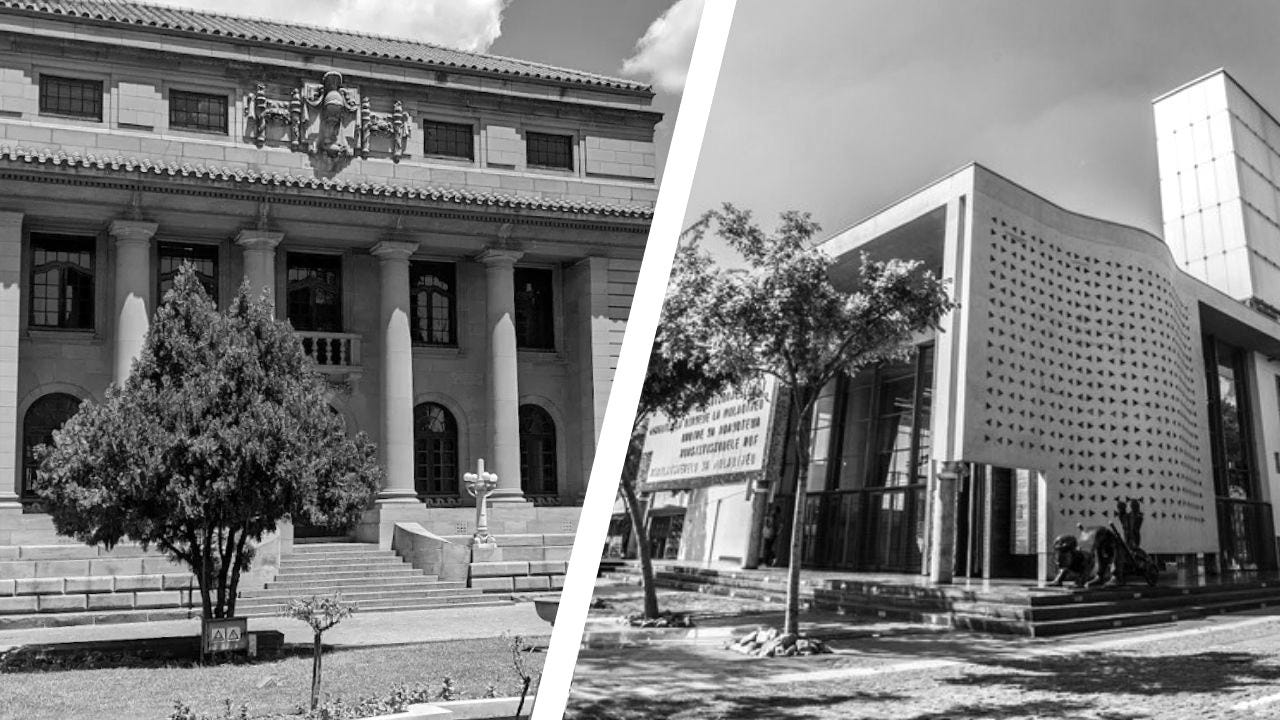
We learn in school that South Africa has three capitals. Pretoria is the executive capital, home to the Presidency and the Union Buildings. Cape Town is the legislative capital, home to Parliament. And Bloemfontein is the judicial capital, the seat of the courts.
The problem is that the third answer is no longer true in any meaningful sense. It persists as an inheritance that nobody has bothered or dared to revise. The Constitutional Court, South Africa’s highest court, sits in Johannesburg, a move that became symbolically decisive when it moved into its purpose-built building in 2004. The country’s constitutional order is most clearly and most ambitiously expressed through its building on Constitution Hill. And there are problems with continuing to give Bloemfontein this symbolic weight.
How Bloemfontein got the status
The story of how South Africa acquired split capitals is a story of political deadlock. In 1909, as the four colonies — the Cape, Natal, the Transvaal, and the Orange Free State — were being consolidated into a union, competing delegations had to agree on where to vest symbolic authority. Pretoria was the Afrikaner camp’s preference as an economic centre. Cape Town, the ‘Mother City’, was the British option. Bloemfontein sat geographically between them, a neutral enough space that nobody felt strongly about either way.
The compromise that emerged — attributed to Jan Smuts — was to split the main functions of state. Cape Town would house Parliament (the legislative capital). Pretoria would house the executive (the administrative capital). Bloemfontein, by elimination rather than enthusiasm, became the Appellate Division of the Supreme Court, and became, de facto, the judicial capital.
Researchers Lochner Marais and Chitja Twala have studied Bloemfontein’s capital status closely in their article Bloemfontein: the rise and fall of South Africa’s judicial capital. They observe that under the constitutional order of the Union, that of parliamentary sovereignty, the legislature was supreme, and the courts were its servants, not its co-equals. The Houses of Parliament (1884) and the Union Buildings in Pretoria (1913) each reflected institutions whose authority was understood to be foundational. The Bloemfontein Appeal Court, by contrast, opened only in 1929 — a full nineteen years after union. The judicial ‘capital’ came mostly as an afterthought.
One further yet important detail that tends to go unremarked: South Africa’s capitals are not declared by any law. They are not the product of legislation or constitutional provision. They are the result of political designation and the product of state and popular rhetoric. This matters for the argument that follows.
The building they built, and what it says
The Supreme Court of Appeal in Bloemfontein is a sandstone building designed in a Renaissance or Roman style by then-Chief Government Architect J.S. Cleland. It expresses colonial confidence. The central portico entrance features sculptured stone with a Roman helmet at the top, described in the court’s own booklet as a biblical symbol — part of the ‘armour of faith’, a reference to Paul’s letter to the Ephesians and his injunction to put on the whole armour of God. Below it, a burning lamp flanked by flaming torches of truth signifies steadfast faith in God and law as a beacon in times of darkness. Engraved keys below invoke the gates of heaven. The side entrances extend the symbolic idiom: Minerva, Roman goddess of justice, law, strategic warfare, and the arts, appears at the south entrance alongside her sacred Owl of Wisdom; Jupiter, king of the Roman gods, at the north. Carved wooden frames above the doors show the scales of justice. The court’s booklet then declares that all of these symbols ‘carry one in thought to the great Roman Law and to other common ancestors of modern systems of jurisprudence.’ Christian theology and Roman mythology are bundled together as a single European inheritance, their differences dissolved into a confident assertion of Western legal origins.
The court’s booklet says that the building’s solemn presence suggests ‘its separation from everyday matters and to elevate justice to a sacred realm.’ The building is inward, elevated, set apart.
It is all very deliberate. All the symbolic additions seek to locate law’s origin in ancient Europe, in the classical and biblical traditions of a colonial legal culture, and stand somewhat paternalistically towards African customs and worldviews and, by extension, its people. One cannot separate these design choices from the thinking of white supremacy that shaped the colonial and apartheid enterprises. The building was made to stand as a righteous symbol of the racist and sexist legal culture of its time.
Then came the National Party in 1948. Political interference in the composition of the Appellate Division’s bench deepened public distrust in the court. As Marais and Twala document, it is ‘certain that the political manoeuvring to control the Appeal Court damaged its image. And it gave Bloemfontein a bad image: it became known as the judicial bastion of the apartheid government, the place where apartheid was legally enforced.’
The stigma persisted. It was actively considered during the negotiated constitutional settlement of the early 1990s. A deliberate decision was taken to separate the new Constitutional Court from the Supreme Court of Appeal: the Constitutional Court was not to be in Bloemfontein, and the SCA was not to be moved to Johannesburg. Marais and Twala conclude that the stigma attached to the Bloemfontein court was one of the major reasons for locating the Constitutional Court in Johannesburg, whose reputation, beyond its economic weight, also carried the moral authority of having been, alongside Soweto, a centre of resistance against apartheid. The transformation of the Old Johannesburg Fort into Constitution Hill speaks to the transformation needed in society.
The significance of (split) capitals
Before I proceed, a quick word on the significance of capital cities as symbolic projects. Marais and Twala argue that capital cities are instruments of nation-building: the power of the nation-state is projected through the spatial layout and urban landscape of the capital, and authority is conveyed by the city’s architecture, monuments, street names, and public spaces. In Africa, most capitals are the product of colonial control, and colonial architecture was used in them to symbolise the power of the coloniser. They remain, even in post-colonial democracies, the primary sites where symbolic changes — in architecture, in monuments, in official names — are deployed to articulate independence, even as inherited patterns of segregation persist in the urban fabric underneath.
Split capitals, Marais and Twala further note, are typically the outcome of political compromise during periods of transition. The separation of judicial from executive and legislative capitals has often been designed to signal the independence of the courts from political power. In Germany, after reunification in the early 1990s, the government relocated back to Berlin, but kept its highest court in Karlsruhe — a deliberate spatial statement that the judiciary would not be absorbed into the political centre. Bolivia maintains La Paz as its administrative capital and Sucre as its legal one. The Netherlands presents a similar division. In each case, the split encodes something the unified capital cannot: a claim that law stands apart from the political moment that produced it.
South Africa’s own split capital arrangement tells this kind of story. But it also tells the story of what happens when a political compromise outlives the conditions that created it.
The missed opportunity
Here is where the story becomes especially pronounced. In 2004, the Constitutional Court building opened in Johannesburg. It announced, in no uncertain visual terms, that the order of society had changed, or that change had been set in motion. Then, between 2005 and 2011, the Supreme Court of Appeal underwent its own physical building extension — a substantial undertaking adding a new main courtroom and additional chambers.
One should also take into account that the SCA (previously the Appellate Division) was established in 1910 as the final court of appeal for South Africa, making it the country’s apex court for over a century. With the interim Constitution in 1994, a dual-apex system emerged: the Constitutional Court handled constitutional matters, the SCA retained jurisdiction over everything else. That arrangement held until 2013, when the Constitutional Court’s jurisdiction was expanded to include issues of significant public interest, effectively giving it universal jurisdiction and completing the SCA’s demotion to second-in-charge judicially.
The SCA building’s extensions were done when it was still a dual apex court. It was thus an opportunity to symbolically incorporate the virtues and transformative spirit of the new constitutional order. The Constitutional Court had just introduced a radically different architectural vocabulary: a building that drew not from Rome or Renaissance Europe but from African communal traditions and a modern, universal view. The SCA had the chance to enter into dialogue with this new articulation of justice, if not a full reconceptualisation of it.
That was not done. The architectural firm responsible acknowledged that ‘one could argue to accept a design approach of contemporary nature’ but that they (including the judges of that court) chose instead to accept ‘the current architectural qualities situated in form, scale and materials used in the existing building.’ The extension reproduced the sandstone, the proportions, the atmosphere. The apartheid-era coat of arms was retained in two of the three existing courtrooms. The new courtroom, while featuring the post-1994 coat of arms, retained the austere, dimly lit atmosphere of the old — evoking a fear-based respect for the gravity of the law rather than the openness the Constitution envisions.
If Bloemfontein wanted a fighting chance to remain the judicial capital, it must have foreseen the need to symbolically represent the Constitution and the transformation it mandates. But that it retained its identity is telling. The Bloemfontein and Johannesburg courts represent competing legal cultures: a conservative culture and a progressive, transformative one.
“The Bloemfontein and Johannesburg courts represent competing legal cultures: a conservative culture and a progressive, transformative one.”
There are many examples of historic buildings transformed by bold modern extensions into something neither approach could have been alone. A striking example is the Museum of Military History in Dresden, Germany. Originally built as an armoury in 1876, used during the Nazi period and later closed, it was reopened in 2011 with a visionary extension by Daniel Libeskind: a sharp steel and glass shard thrust through the neoclassical facade, creating a dialogue between old and new that forced the building to reckon with what it had been. The architect described the existing building as representing ‘the severity of the authoritarian past’ and his intervention as reflecting ‘the transparency of the military in a democratic society.’ The same cannot be said for the Bloemfontein court.
The court building, gated like a fortress and devoid of public accessibility — photography generally not permitted, visitors probed upon entry — sends an implicit message of guarded exclusivity that sits uneasily with the constitutional spirit it serves.
What Johannesburg offers instead
Wessel le Roux, the South African legal scholar whose work on the architectural dimension of post-apartheid constitutionalism is essential reading on these questions, describes the Constitutional Court building as ‘an important aesthetic index of, or aesthetic analogy to, the transformation of post-apartheid law and legal culture.’ Le Roux identifies what he calls an ‘architectural dissonance’ in the post-apartheid legal order: the old courts and their inherited symbolism remain standing and in use, while a new constitutional vocabulary insists on a different imaginary. The question is which vocabulary should set the tone.
The Constitutional Court makes the case for itself through every design decision. Unlike the SCA, which affirmed the parliamentary sovereign status quo without reaching beyond it, the Constitutional Court operates primarily as a transformative aspiration. It gives architectural form to the legal culture that is yet to be fully realised. It does not describe South African constitutionalism as it is; it prescribes — aesthetically, spatially, jurisprudentially — what it ought to become.
Albie Sachs, who was part of the Court’s first bench, describes in Art and Justice the building’s consciousness of ‘justice under a tree’ as communicating something ‘between subliminal and liminal’. The tree, as the Court’s logo and governing spatial metaphor, presents justice not as the property of Roman law, not as a Roman goddess blindfolded and detached, but as something that grows, that shelters, that requires tending. It roots constitutional authority in African communal practice while speaking to a planetary scale of interconnection. As Sachs explains, the logo had to convey the Court’s ‘place in Africa’, moving away from ‘clichéd images of the scales of justice and Roman columns.’
Le Roux observes that this building is a ‘physical signpost’ of post-apartheid legal theory. The transformed site is not gated off from the surrounding community. This was a deliberate design decision, and it should be understood as a constitutional one.
The shift has already happened, but not officially
Because South Africa’s capitals are not declared by law but are the product of political designation and popular rhetoric, the question of how to change the judicial capital is a question not of legislation but of narrative.
However, formal political announcement of a capital shift by a minister, a department, or a political party, would further pull the judiciary into political contestation at precisely the moment when the courts are carrying an extraordinary constitutional burden. The judiciary should not be a prize claimed by politicians. Its symbolic centre should rather not be the subject of parliamentary debate or executive proclamation.
The judiciary itself may make such a proclamation, but has likely not done so in all the years since the establishment of constitutional democracy for other reasons. Legal culture changes incrementally as it remains conservative when it comes to change. The courts avoid upsetting the system of hierarchy, convention and stability.
Alternatively, the organisation that exists to tend the national brand, Brand South Africa, the official custodian of South Africa’s nation brand incorporated as a Trust and a schedule 3A National Public Entity, could reach this conclusion through its own processes of research and public communication, and announce it not as a political act but as a recognition of what is already evident. It would cause a buzz. It would generate discussion. And then it would settle, and become accepted, and the curriculum would eventually be updated. We are working with matters of the national consciousness that need to be tended to.
Bloemfontein would take a symbolic knock, and no doubt it holds on to its status as a matter of pride. But — no shade — it does not really compete in the realm of national attractions. It remains an important, if not key, jurisprudential centre. The building is well-maintained compared to other courts. But the city’s claim to judicial capital has been honorary, and not productive, for some time.
This is not a proposal for change but an acknowledgment. The Constitutional Court is South Africa’s highest court. Constitution Hill in Johannesburg is the physical signpost of the country’s constitutional order at its most ambitious, its most carefully imagined, its most deliberately African, universal expression.
Johannesburg is already South Africa’s judicial capital. Here’s to acknowledging that.


Great piece. I wonder if JHB isn’t something even more and post-categorical than the “real” judicial capital.
It represents to my mind rather the interconnection and interplay of human struggles (the political and the socio-economic) with law. In more ways than one. The CC then is effectively a court of final equities has this unique navigational mandate.
Bloem, on the other hand, represents the law as it is on an operational/procedural, day to day application, but now ultimately qualified by the CC, which represents the next and final level of adjudication which transcends the original “pure” category of law.
In this way, the four major cities get something to apply towards the future, whilst drawing on a measure of heritage, contested nonetheless.
I have been quite naive about how I understood the history of the SCA. For the most part, I was drawn to it by its history, its weight (the second highest court), the idea of it, but I never once unpacked that history or interrogated it the way you just have.
I walk past the columns most days. And reading this, I realised I never asked what those columns were doing there, or why they look the way they look, or what it means that I felt drawn to that specific aesthetic without ever asking where it came from.
I think what unsettles me most is not the colonial/Roman architecture itself. It is that I mistook my attraction to the court's history for an understanding of it. Those are not the same thing, and this piece is the first time I have had to sit and reflect on that gap.
I am going to look at that building differently now. Thank you.