

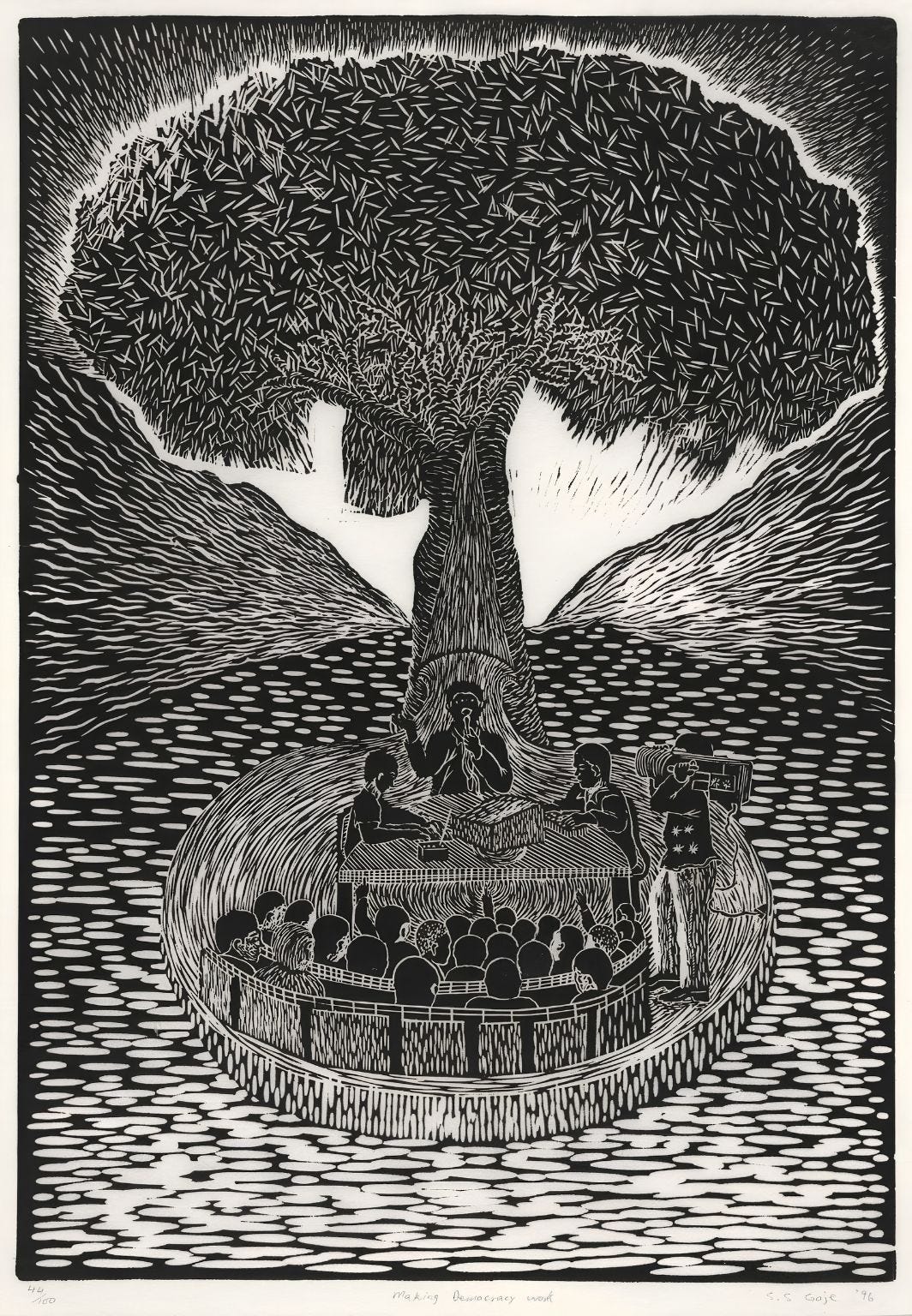
When the architects of the new constitutional order set about giving it an identity, they did something quietly radical: they altered the inheritance. There would be no blindfolded goddess holding her scales aloft, no sword to signify the state’s monopoly on force, no Roman columns, no gavel, and no figures presiding from a height. The symbols that had carried Western law for centuries — and that still crowd the letterheads, websites and imagination of much of our own profession — were set aside. In their place, the first bench of the Constitutional Court, with Justices Albie Sachs and Yvonne Mokgoro among its members, chose something humbler and more rooted: a group of people standing together under a tree.
It is worth pausing, at 30 years of the Constitution, on how deliberate that choice was, and how much it still asks of us. The aesthetic of justice under a tree is not inconsequential decoration. It is an argument about where law comes from, who it convenes, and what it owes the world it governs. We have lived with it for three decades, mostly without recognising its full import.
A tree, not the scales
The Constitutional Court’s logo was unveiled by Nelson Mandela on 14 February 1995, the day the Court was inaugurated. It shows a tree of 11 branches sheltering 11 human figures who stand beneath it. The trunk and branches trace the Y-shape of the national flag when draped vertically. At one level, the reading is plain: the Constitution, and its guardian the Court, are a tree that shelters and protects. But the same tree is also a marker in the landscape — the place you walk towards to gather and to argue out what matters. The 11 branches invite a second reading too, of the many sources of our law: the Constitution as trunk, and sprouting from it legislation, the common law, precedent, customary law, religious personal law, international law and the old authorities.
The human figures under the tree alternate in shade between black and white, and the four in front carry alternating masculine and feminine features, while those behind remain undefined — a quiet visual statement of the founding commitments to non-racialism and non-sexism. Gender neutrality is introduced as through the address of “Justice”. The number 11 does double duty, for the official languages and for the justices of the Court. The people under the tree are “we, the people”, in whom and in whose name sovereign authority is vested.
Justice Sachs made a point about the relationship the image sets up: as much as the tree shelters the people, the people tend the tree. The protection runs both ways. That reciprocity — between the Constitution and those who live under it, and, as I will come to, between humankind and the living world — is the whole moral of the picture. The logo, designed by Carolyn Parton with the first bench, was a conscious turn away from what Justice Sachs called the clichéd images of scales and Roman columns. It had to show the Court as a source of protection for all, to declare its place in Africa, and to root the Constitution in the struggle for rights. The circle that contains it is left open rather than closed, and no particular species of tree is named — the image resists being pinned to any single tradition, so that many may stand under it for their own reasons.
The image has found some uptake: for example, the Legal Practice Council features a tree in its logo, and Thulamela Chambers speaks to its historical roots, but the idea remains, for the most part, quiet symbolism rather than something the profession has collectively claimed or made its own.
The logo made inhabitable
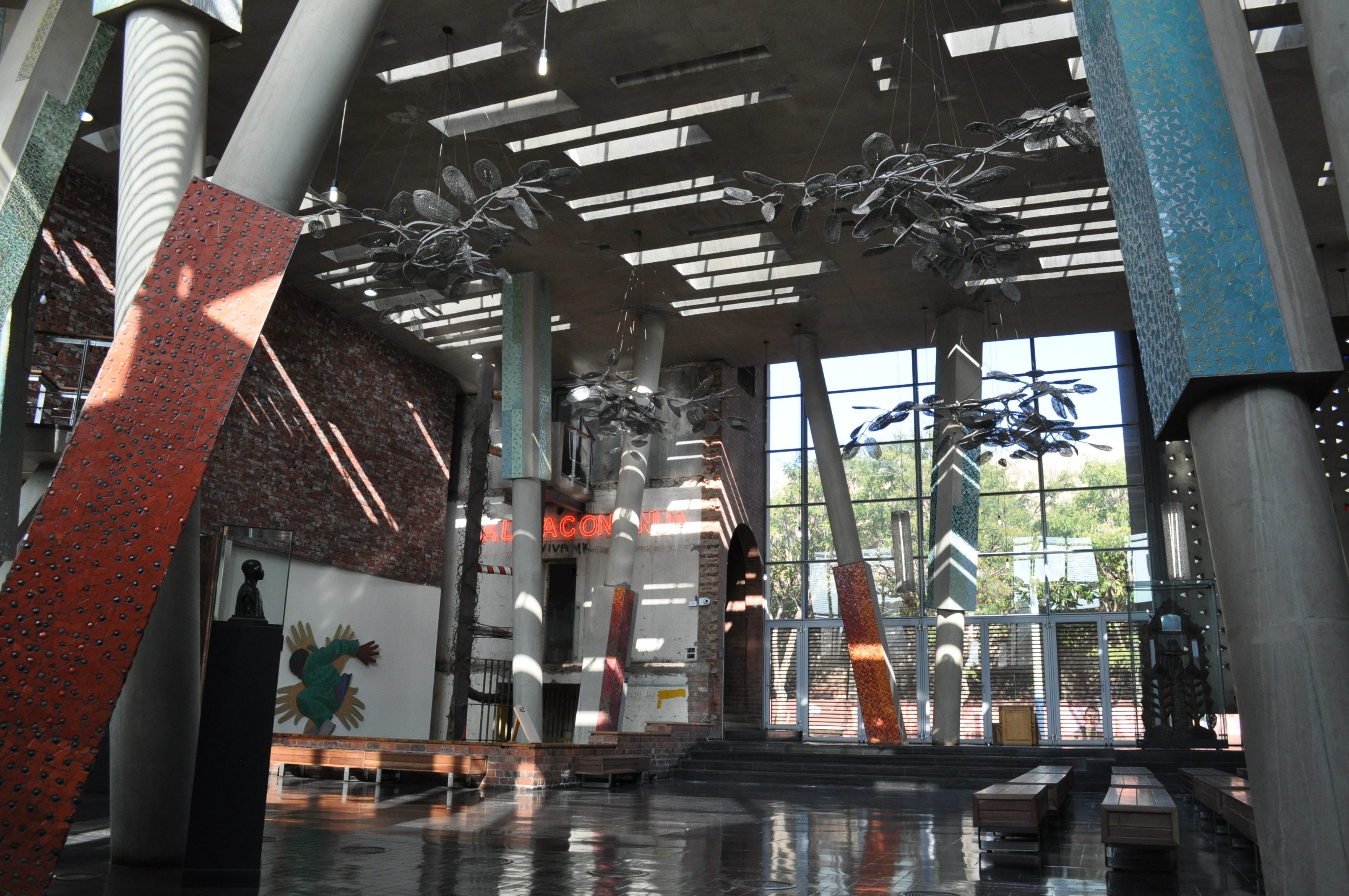
If the logo states the idea, the building enacts it. The Constitutional Court’s home on Constitution Hill, opened in 2004, turns the emblem into a space you can walk into. The foyer’s columns lean as they rise, so that they read as trees rather than the upright, imposing columns of classical court architecture. Jane du Rand’s mosaic runs from reds and ochres at the base — soil, root, organic matter — to blue-greens above, where greenery meets sky. Walter Oltmann’s wire chandeliers hang overhead as a woven canopy of leaves; skylights drop dappled light across the day; benches and stumps suggest seating on fallen wood; the floor steps in levels like the topography of a natural amphitheatre. The chamber itself is set in a semicircle to evoke a gathering in a kraal or under a tree, the Court’s logo watching over proceedings from behind the judges and repeated on counsel’s lectern.
The architect Andrew Makin describes the foyer as the building’s handshake — a cover that hands you, calmly and all at once, everything the Court is about. Thenjiwe Mtintso, who sat on the design competition jury and had herself been imprisoned on that site, put it more directly: the building had to project a protective tree, the kind under which elders sit to resolve a village’s disputes. It had, she said, to be like an imbizo — the isiXhosa word for the gathering a traditional leader calls, with its Sesotho and Setswana cousins in khotla and lekgotla. The same arboreal grammar carries through the Court’s growing art collection, which has gathered the theme deliberately — among the works is Gille de Vlieg’s 1988 photograph of a community meeting under a tree to discuss a threatened forced removal in KwaZulu-Natal, acquired in 2022, which ties the symbol back to the spatial violence the Constitution was written against.
There is a rhetorical mechanism at work in all of this. When you arrive at the apex court, you find yourself in the tree’s proverbial shade; when you then catch sight of the logo on your way to the chamber, you might realise that you have become one of the figures in it. The distance between the picture and the viewer collapses. You are not looking at the constitutional scene; you are partaking in it.
Green for the earth
Beyond the logo and the building, worn on the body, is a detail we tend to read as mere robing. When the first bench declined the old black and red gowns and chose green, that was not an aesthetic whim. Justice Mokgoro, who led the design with Sachs, has explained that green was chosen to represent the earth. Forest-green judicial robes are close to unheard of internationally. But the colour completes the argument the logo begins: the judges do not merely preside over the tree’s values, they wear them, becoming something like keepers of the tree — its rootedness, its openness, its place within rather than above the natural order.
A symbol hiding in plain sight
Here is what I think we have missed. We notice the scales of justice everywhere, because we expect them. We do not notice the tree, because we have not been told to look. Across the profession we still reach by reflex for the goddess, the scales, the gavel — none of which South Africa ever formally adopted, all of which have simply settled into our visual habits through popular culture. Meanwhile, the actual emblem of post-apartheid law, the one the founders chose with care, is a tree and the people who stand beneath it.
It was there from the start, and not only at the Court. The Constitutional Assembly’s public campaign around the making of the 1996 Constitution — run through its own media department with the agency Hunt Lascaris — leaned on the same imagery long before most of us were paying attention. Its illustrations gave us vistas of an undulating valley with a tree atop a hill as the gathering place of a newly imagined national community. The now-famous Constitution booklet, the one that has become the popular face of the document, sets a tree above the preamble, distilling the whole aesthetic into a single picture. Nowhere did the Assembly announce in so many words that a tree would stand for the Constitution; it simply let the visuals carry it, plainly having taken its cue from the Court’s logo, already unveiled a year before. The tree, in other words, has been doing constitutional work in the public imagination for three decades. We have just been slow to credit it.
Why a tree
The reason the image works is that it descends from a real practice, not a metaphor invented for a brochure. Communities have long gathered under trees to deliberate and to judge, and that practice carries an unmistakable set of values: openness, transparency, participation, the patient airing of competing accounts. This is not a parochial inheritance. The Somali tradition of arbitration under acacias is literally named xeerka geedka, “the law of the tree”; Rwanda’s gacaca convenes justice in the open; the prophet Deborah, in the Book of Judges, gave judgment beneath a date palm. Eden also comes to mind, as do other creation mythologies, such as the World Tree. Set that lineage against the figure the tree replaced — a blindfolded, disembodied woman bearing a sword that signifies state violence, her scales a coolly rational instrument of weighing — and the difference in temperament is stark. The scales are clever; the tree is heartfelt. One disembeds the law from the world; the other is implanted.
The most theoretically developed articulation of what all these practices share is found in Jean-Godefroy Bidima’s account of the West African palabre — the tradition of collective deliberation that often occurs under a palaver tree, presided over by elders yet open to all, in which ordinary space is transformed into a signifying arena where truth is sought through open-ended dialogue rather than adjudicated from on high. For Bidima, palabre is nothing less than a “transformation of the idea of justice”: a shift of power from domination-over to collaboration-with. It demands that each participant relativise their own convictions and hold themselves open to having their terms altered by discussion. That demand — for a willingness to relinquish some sovereignty to the common good — is exactly what the tree over the foyer of Constitution Hill is asking of everyone who gathers beneath it.
And it is here that I think the symbol carries its deepest charge, which I would call a form of environmental ubuntu. The figures under the tree express our interconnectedness with one another — masculine and feminine, black and white, gathered under one canopy — but the tree extends that relational ethic outward, to our connectedness with the living world itself. Trees have always been read as emblems of vitality and self-regeneration, life-reaffirming and death-denying, neither quite male nor female, standing for nature as such. To picture the law this way is to make a claim that the philosophy of ubuntu, drawn beyond its usual anthropocentric reading, already contains: that human flourishing is not separable from the flourishing of everything we depend on. The image quietly refuses the old conceit that law is law for people only, with nature as an object held at our disposal. It signals a broader African cosmology of interdependence instead — and it does so at exactly the historical moment, the age of extraction and ecological crisis, when that refusal has become urgent rather than ornamental.
More than branding
It would be easy to mistake all of this for a tasteful exercise in making the law look more African — a superficial rebrand. It is the opposite. The turn to the tree is a substantive shift in how we understand the constitutional project itself, and it belongs at the centre of what we mean by transformative constitutionalism. Law is, in large part, an enterprise of persuasion: it works through reason and the written word, but also through the performance of appearing in court, through the spaces we build for judgment and the symbols we hang above it. Those symbols are not inert. They structure how we, and the public, understand where authority sits and what it is for. Justice under a tree is best treated not as a logo but as a constitutional philosophy — one capacious enough to convene a plural public under a common canopy, and honest enough to register the vulnerability of the very order it shelters. It is, in the end, a concept that can become justiciable: that is, to be used and developed in (environmental) jurisprudence.

Our constitutional symbol
This brings me to a tension that 30 years have not resolved, and that every advocate sees without quite seeing. Above the judges, traditionally, sits the national coat of arms — the emblem of the state. It appears on the masthead of many judgments and signals that the act of judging is done in the name of the state. But that is precisely the confusion. Under a supreme Constitution, courts do not draw their authority from the state; the state, like the courts, draws its authority from the Constitution. To keep the state’s arms above the bench is to imply the older, inverted orders of monarchy and parliamentary sovereignty.
Increasingly, some divisions have moved away from the coat of arms towards the emblem of the Office of the Chief Justice — the judiciary’s own logo, now placed above the bench in the Mbombela High Court and used to mark its judgments. That emblem at least gestures in the right direction: it features a book, standing for the Constitution, which more clearly locates the source of judicial power where it belongs. Yet it reaches the right idea by the wrong route. It assembles its authority, almost in the manner of clip art, from the sun-rays of the state’s coat of arms, the Western scales, a Roman laurel wreath and the book — rehashing the very staid conventions the Constitutional Court had the imagination to leave behind. The result, across our courts, is an uneven and frankly incoherent symbolic order: the coat of arms in some courtrooms, the judiciary’s emblem in others, the tree at the apex alone.
My argument is this: The symbol that should come through — not only at the Constitutional Court but in our High Courts and on our judgments — is the tree. It is the truest emblem we have of post-apartheid constitutional democracy, because it shows, more clearly than any book or scale or coat of arms, that the power of the judiciary and the whole legal function is vested in the Constitution itself, and that the Constitution in turn is rooted in the people who stand under it. Aligning the symbols of our courts with the constitutional order they actually serve remains, at 30, an unfinished task. It is one worth finishing. We have a better symbol than the one most of us are still using. In which we can take national pride. One that is more sober than the rainbow, more tempered than the flag. It is standing patiently.
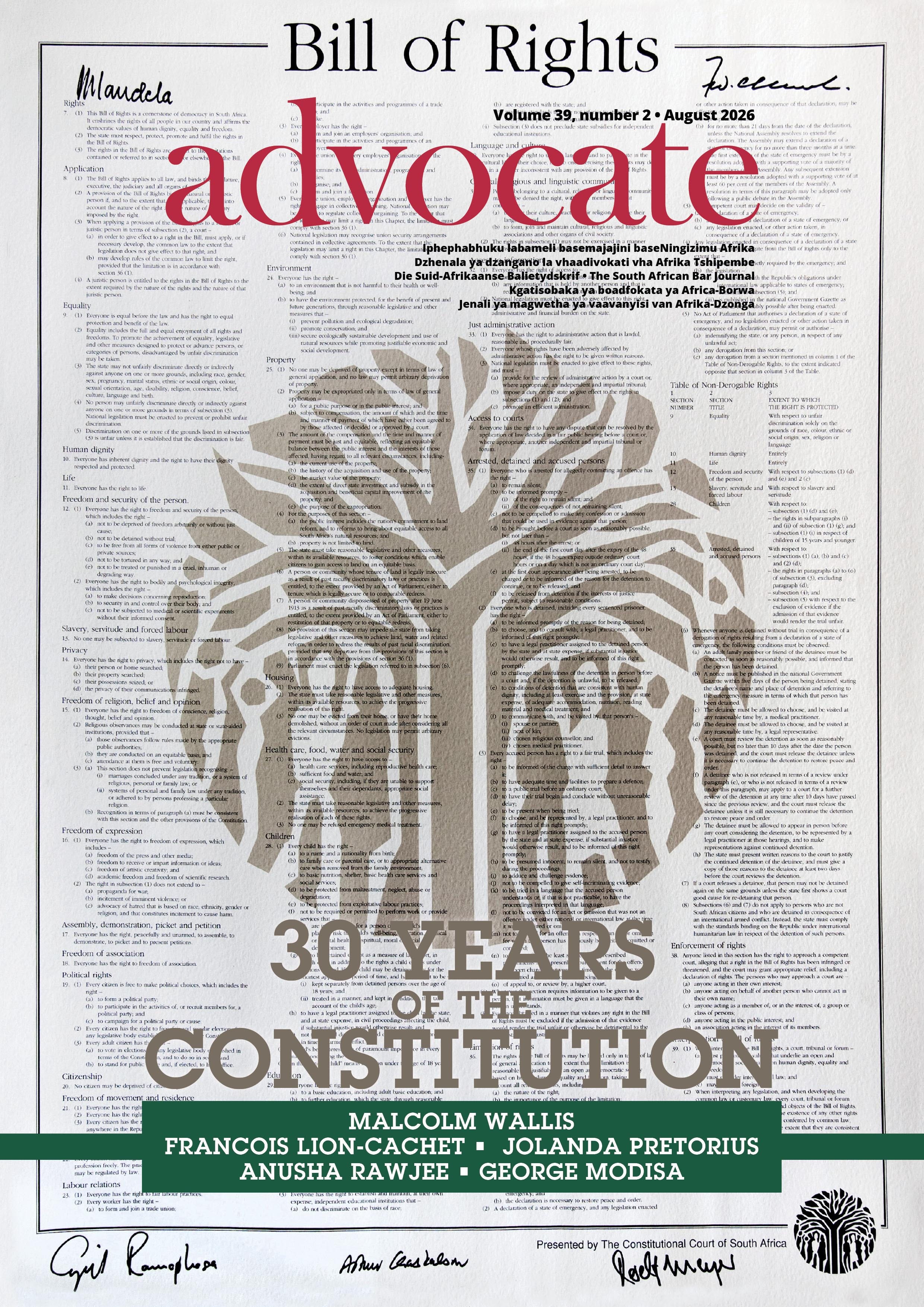
A version of this article first appeared in Advocate, the South African Bar Journal, volume 39, number 2, August 2026. View the published piece here.
A further, shortened version appeared in the printed version of Daily Maverick on 4 September 2026, titled ‘The tree of justice must spread’.