

The following reading was prepared for the Climate Litigation Reading Group (CLiSA), for a session I presented on 24 June 2026 at the Thulamela Chambers.
Also see:

The law as a visual enterprise
My doctoral thesis begins with the claim that the law is a story we tell, and that these stories are subject to change, renewal, and invention. The public encounters law primarily not as the written content of rules, but as Wessel le Roux puts it, in an aesthetic, a “coalescence of images, rhetorical forms, metaphors and other tropes, perceptual modes and sensibilities, dramatic tensions, sensory impressions, and feelings.” Law relies on symbol, spectacle, spatial arrangement, and ritual not merely to project its legitimacy, but to constitute the experience and persuasive legitimacy of legality.
The thesis pursues this claim that law is inescapably a visual enterprise, along with other forms of intellectual persuasion, across several sites: the foundation rhetoric and visual symbolism on which the post-apartheid constitutional order rests, involving the architecture of the Constitutional Court and the apex courts that preceded it, these courts’ art collections, and the virtual spaces through which the law now projects itself. But the constitutional order’s organising image, around which each of these investigations turns, is a tree. Specifically: the tree of the Constitutional Court’s logo, and what that tree demands of us as lawyers, scholars, and judges at this particular historical moment.
What follows is not a summary of my thesis, but rather a distillation and further development of one argument within it – the one I think matters most for climate litigators and the judiciary – and an invitation to take the argument seriously as a jurisprudential resource.
The tree is part of our constitutional philosophy
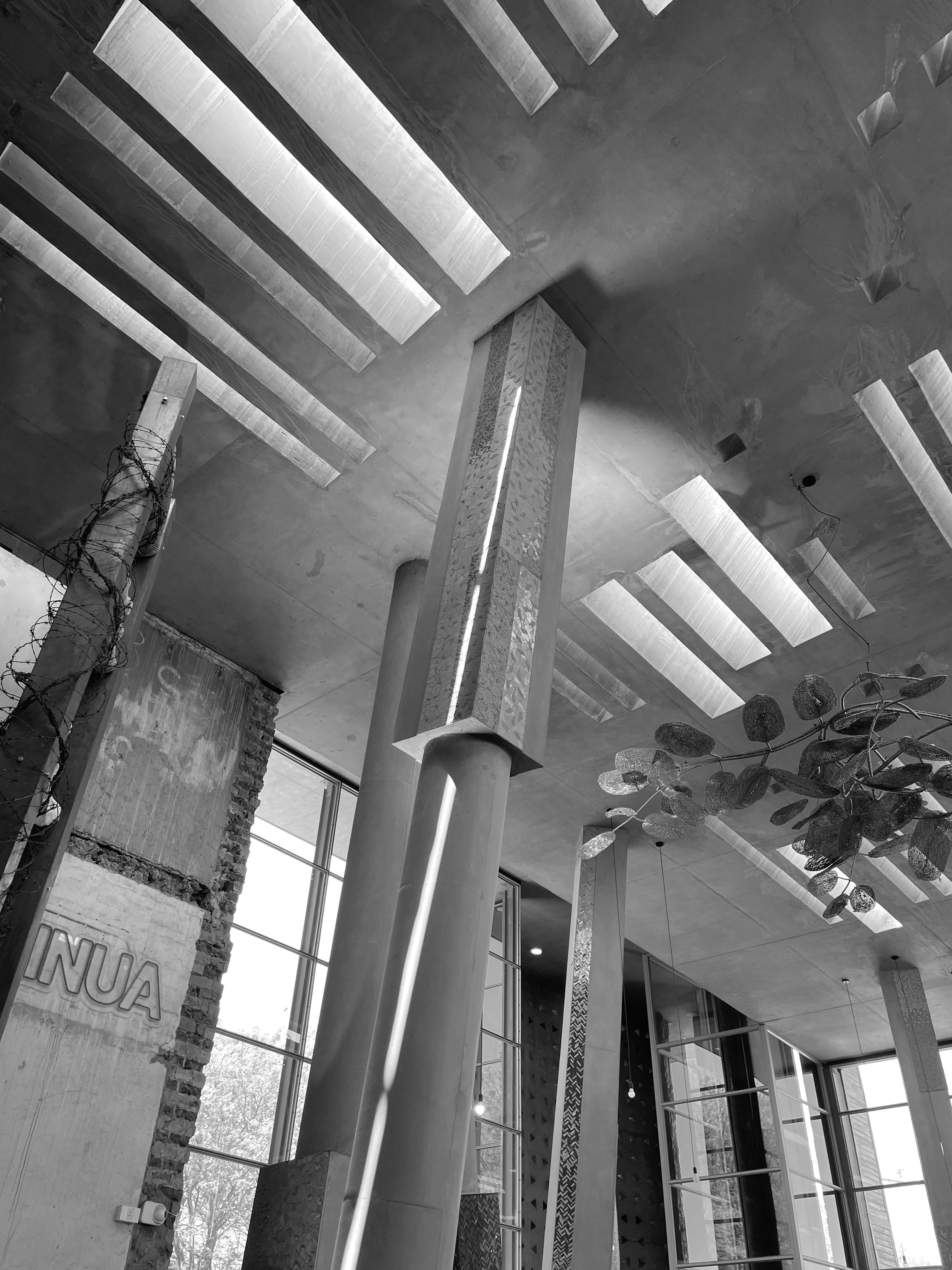
When the first bench of the Constitutional Court designed its logo in 1995, it deliberately turned away from the inherited symbols of Western law: no blindfolded goddess, no scales, no sword, no Roman columns, no gavel. In their place, they chose a group of people standing together under a tree. That image has since anchored the Court’s architecture, its art collection, the design of Constitution Hill. The image was adopted in the Constitutional Assembly’s public campaign promoting democratic constitutionalism and a tree is placed above the preamble of the famous Constitution booklet. Subtly, but consistently, it has been pressed as the image for our constitutional order.
I have argued elsewhere [link forthcoming, Advocate journal] that this image is better understood as a constitutional philosophy than as a mere logo. The tree shelters the people under it, but the people also tend the tree; the protection runs both ways. The image convenes a plural public under a common canopy and, crucially, plants the law in the living world rather than elevating it above it. The human figures alternate in race and appearance of gender, and the circle that contains the image is left open. All of this is deliberate. It signals broad inclusion.
What I want to focus on here is the dimension of the image that is most directly relevant to environmental litigation: its refusal of anthropocentrism. The people in the logo do not stand over nature; they stand within it. The law they instantiate is not law for people administered above the natural world, but law exercised in relation with it. That is a quiet but radical claim, and it has been standing in the Constitutional Court’s two buildings since 1995, waiting to do legal work.

Environmental ubuntu: the philosophy the image encodes
The philosophical concept that underpins my claim to justice under a tree as a justiciable concept is, if not the international concept of interconnectedness, the more local iteration that Edwin Etieyibo calls environmental ubuntu. The familiar reading of ubuntu – “I am because we are” – may be (mistakenly) understood as anthropocentric: it describes the interdependence of human beings with one another as central to legal being in the world. Etieyibo argues that this anthropocentric reading is philosophically inadequate and practically insufficient. African ontology, he contends, is energy-oriented, perceiving the world through vitality and liveliness; it carries within it the resources to extend the relational logic of ubuntu beyond the human community to encompass all living beings and the ecological systems that sustain them. ‘We’ is not limited to the human.
Environmental ubuntu is, in essence, an ethic of shared concern that treats individual flourishing as genuinely possible only when the interests of all – human and non-human alike – are enhanced. It can be valued as an African moral contribution to a global necessity. By other names, the concept and world-understanding is evident in indigenous cultures and spiritualities around the world, and, increasingly, in modern philosophical shifts.
This interconnectedness, I argue, is what the tree image holds. Trees have long been read as symbols of vitality and self-regeneration, of peaceful cohabitation, of that which is solid and in good health. As the anthropologist Laura Rival puts it, trees stand for nature in the sense of environmental health and community welfare. The Constitutional Court’s tree does not merely represent an inherited cultural practice of gathering and deliberation under trees (though it does that too, as a visualisation of the lekgotla, and imbizo, as the more immediate reason the symbol was adopted in the first place, to advance indigenous justice practices and worldviews). It makes a normative claim by its very nature: that law must aspire to durability, vitality, and peaceful coexistence with the natural world. In the Anthropocene, that claim has become urgent in a way the Court’s founders could perhaps only half have anticipated.
The law in the Anthropocene
The concept of the Anthropocene – the geological epoch in which human activity has become the dominant force shaping planetary conditions – is no longer merely a rhetorical device for environmental advocates. As Louis Kotzé writes, it has moved to the core of epistemological and ontological enquiries about the legal systems that govern human behaviour on earth. The societal ordering maintained by anthropocentric law under former Holocene conditions is no longer tenable; the biospheric conditions that allowed it have already been irrecoverably disturbed.
Tim Stephens puts the intellectual consequence plainly: Enlightenment thinkers assumed a separation of the natural and human domains, but it is now clear that we have always been in a social-ecological system that is intermixed, interdependent, and inseparable. Andreas Philippopoulos-Mihalopoulos describes what he calls an “Anthropocene-turn” in legal thinking – a new language and theoretical underpinning for regarding the legal system, one that treats the legal order not as a human structure imposed on nature, but as a connected field in which everything affects and is affected by everything else. Indigenous cultures and worldviews, long dismissed by anthropocentric legal orders, offer precisely the relational ontologies that a sustainable jurisprudence requires.
The South African legal scholar Melanie Murcott has developed the most directly applicable framework for our purposes: her legal theory of transformative environmental constitutionalism. Murcott’s argument is that judicial application of this theory “could yield law more responsive to both the struggles of vulnerable people and the rapid deterioration of the Earth system in the Anthropocene, as related concerns.” Crucially, she frames social, environmental, and climate justice as interconnected rather than compartmentalised – a socio-ecological systems perspective that breaks the habit of treating environmental rights as a specialist subcategory of constitutional law rather than as one of its structural foundations.
Saskia Vermeylen pushes the ontological implication further. The turn to non-human subjects – fauna, flora, rivers, mountains, the sky – is not a sentimental addition to existing law but a challenge to the law’s deep entwinement with anthropocentrism. By limiting the law to human language, she argues, nature is excluded from political life and legal agency. Nature communicates through its own aesthetic way of signification, requiring our attentiveness. A dead fish in a polluted river, a tree felled without just cause, declining and diseased populations of natural life forms – these are not merely evidence of human harm; they are, on this reading, communications that the law has not yet learned to hear. Accepting non-linguistic representations as a form of legal language opens new possibilities for extending sovereignty beyond both the state and the human.
Lynda Collins makes the litigation-focused corollary explicit: most environmental litigation currently revolves around the purview of environmental (or administrative) legislation, constraining judges within the boundaries of existing law that is “largely concerned with facilitating, or at best mitigating, industrial activity.” Judges often defer to governmental expertise. Yet this deference has contributed to the existential crises now confronting the planet. As part of the project of transformative constitutionalism, judges have been liberally enabled to pronounce on human rights abuses and inequalities; a more ecologically responsible jurisprudence is as important, if not more.
Justice under a tree is, in essence, a counter to environmental apartheid – the ongoing severance of a healthy environment from societal consciousness, enforced by spatial zoning and by the logic of produce, consume, burn, pollute, discard. That severance is not evenly distributed. The communities most devastated by ecological degradation are those already on the margins; the plundering of the natural world and the plundering of people proceed together.
Justice under a tree is, in essence, a counter to environmental apartheid – the ongoing severance of a healthy environment from societal consciousness, enforced by spatial zoning and by the logic of produce, consume, burn, pollute, discard.
Section 24 and its limits
South Africa’s constitutional dispensation is grounded in three fundamental values – human dignity, freedom, and equality – that relate primarily to the human person and not to the environment. Section 24 of the Constitution grants everyone the right to an environment not harmful to their health or wellbeing, and to have the environment protected for the benefit of present and future generations. This was, as Anél du Plessis has shown, a watershed moment in making the law more environmentally minded; it influenced the environmental provisions of Zimbabwe and Kenya’s constitutions and placed far-reaching obligations on governmental authorities.
But it is not enough. South African courts have mostly focused on what is potentially harmful to physical human health, and section 24’s reference to “everyone” has never been definitively extended through legal interpretation to encompass living things beyond the human. Du Plessis herself, though she argues for the broadest possible reading of “well-being” – a term that can carry spiritual, psychological, aesthetic, cultural, and relational meanings – stops short of advocating environmental rights as an end in themselves, beyond human benefit. The National Environmental Management Act follows the same frame, orienting the whole legislative structure toward the benefit of present and future generations rather than treating the environment as an end in itself. The Constitutional Court is now, in 2026 (in a challenge brought by the South African Hunters and Game Conservation Association), considering whether a statutory definition of animal “well-being”, introduced to the National Environmental Management: Biodiversity Act (NEMBA) as amended in 2022, is constitutional.
Christopher Stone’s foundational 1972 article – “Should Trees Have Standing?” – argued that granting legal rights to the environment, both in its parts and as a whole, is neither fanciful nor devoid of operational content, but legally achievable and normatively necessary. His argument was that natural objects should be able to institute legal proceedings in their own names, that injury to them must be considered by courts, and that any remedy must benefit the natural entity itself. As Klaus Bosselmann argues, there is growing support for the hypothesis that “ecological integrity must attain the same fundamental normative status in law as human rights, the abolition of slavery, the rights of women, and the rule of law.” If ecological integrity were so established, it would be read in conjunction with existing anthropocentric norms – balanced against them where necessary, but no longer subordinate to them by default.
This is the direction the law needs to move. It only moves if we take it there.
Justice under a tree as a justiciable concept
As far as the case law reveals, the phrase “justice under a tree” appears in only one judgment, by the Supreme Court of Appeal (Van Breda v Media 24 Limited; National Director of Public Prosecutions v Media 24 Limited from June 2017), and there it enters through an article by former Deputy Chief Justice Dikgang Moseneke, invoked in support of the principle of open justice. That single instance is telling in two ways. It confirms that the concept has already found its way into judicial reasoning, even if obliquely; and it shows that when it did, it was used to do constitutional work well beyond mere symbol – to support a substantive rule of law value. The idea is capacious enough to carry many such concerns: openness, transparency, participation, and responsiveness. Its environmental import, however, has not yet become written legal precedent; for now, it operates as visual jurisprudence – embedded in the Court’s aesthetic, but not yet extracted into the normative language of judgments.
The proposition I want to put to (environmental) lawyers: justice under a tree should be advanced in litigation as an underlying concept of what our constitutional order envisions. Because it is.
The proposition needs to be made carefully, and I do not make it as a claim that the symbol alone generates enforceable rights. I make it as a claim that the symbol is constitutive of the constitutional aesthetic – the distribution of the sensible, in Rancière’s terms, that determines what can appear and be thought within the legal order – and that it therefore properly informs the normative basis on which courts develop environmental jurisprudence.
The argument has several mutually reinforcing steps.
First, the symbol is not a mere decoration. It is a key part of the transformative constitutional project that has societal change as its very purpose. The Court’s logo, its symbolic architecture on Constitution Hill and further expression through the Court’s art collection, and the foundational public communication of the constitutional project evince this. The Constitutional Court justice Yvonne Mokgoro chose green robes for the bench to represent the earth in line with the concept of justice under a tree. These are not decorative decisions; they are jurisprudential ones.
Second, the symbol encodes a specific normative claim. The image of people standing under a tree, as I argue, carries an environmental ubuntu – an ethic of interdependence that extends beyond the human community to encompass the living world on which it depends. That claim is available to be drawn out of the symbol and given legal content. It does not require an amendment to section 24; it requires an interpretive act of the kind courts perform routinely when developing the normative content of constitutional rights. Ubuntu is accepted as a constitutional norm even without it being included by name in the Constitution. The academic and political concept of “intersectionality” has also become justiciable and has found its way into judgments of the Constitutional Court. There is no reason, to my mind, that justice under a tree couldn’t be developed in a likened way.
Third, there is precedent for exactly this kind of move. The Johannesburg Principles on the Role of Law and Sustainable Development, adopted in 2002 by chief justices and senior judges from around sixty countries at a symposium hosted by Chief Justice Chaskalson, affirmed an environmental emergency and called on judiciaries worldwide to develop legal precedent with urgency. Ecuador’s Constitution explicitly draws on indigenous “cosmovisions” in its recognition of the rights of nature, specifically by enshrining the concepts of Pachamama (Mother Earth) and sumak kawsay (Kichwa for “good living” or communal wellbeing). The legal infrastructure for a more-than-human jurisprudence is being assembled across multiple jurisdictions; the question is whether South African courts will contribute to its burgeoning.
Fourth, and most directly: judges are not merely spectators of the climate and ecological crises. Judges have shown, across the project of transformative constitutionalism, that they are empowered to develop constitutional norms – not to defer responsibility to other spheres of government, but to give shape and legal force to the values the Constitution embodies. The visual and symbolic foundations of the Court are one source of those values. Stone’s appeal to the judiciary still resonates: the court may be at its best “not in its work of handing down decrees, but at the very task that is called for: of summoning up from the human spirit the kindest and most generous and worthy ideas that abound there, giving them shape and reality and legitimacy.”
An invitation
I close with a proposal rather than a conclusion, because this is the kind of argument that requires collaboration between scholars and practitioners to develop into something a court can use.
Justice under a tree is not only a description of where communities have historically gathered to deliberate and judge. It is a constitutional philosophy – one that the founders of South Africa’s post-apartheid legal order embedded in the most visible symbols of the constitutional project. That philosophy carries an environmental imperative: it refuses the anthropocentric conceit that law is law for people only, and insists instead on a relational ethic of interdependence that extends to the living world. Various scholars have contributed to a coherent conceptual framework for South African constitutionalism to serve as a transformative environmental force within its broader aims of justice. The image distils it.
What remains is for practitioners to carry it into pleadings and heads of argument, and for judges to have the intellectual resources and the vocabulary to receive it. This piece is an attempt to help build those resources. The case law that will matter most in the age of environmental crises has yet to be written. But the symbol from which it could draw its deepest authority is already in the minds of every lawyer who has ever appeared at Constitution Hill. The purport of the concept of justice under a tree must not be undervalued.
See this article for links to a wealth of South American legal scholarship on eco-centric normativity (Amazonian living forest constitutionalism) https://criticallegalthinking.com/2026/05/14/the-amazon-as-juridical-ecosystem-planetary-urgency-juridical-possibility/