

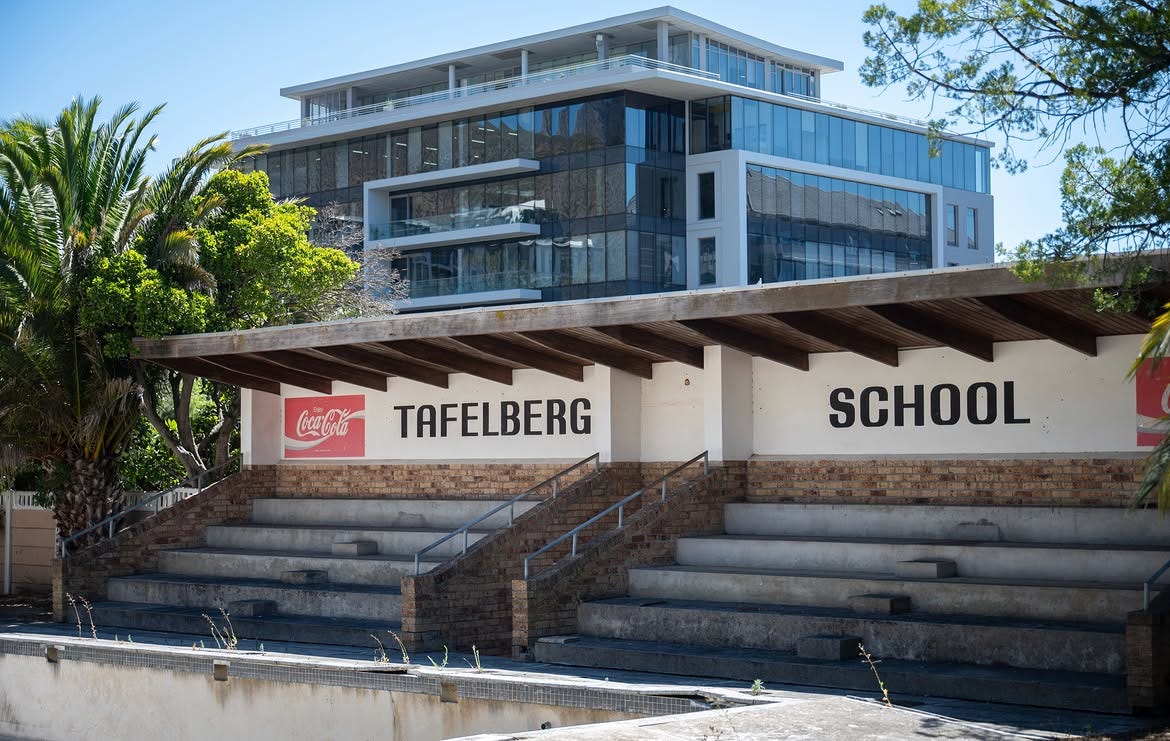
I am intrigued by how philosophical concepts become law; i.e., how ideas travel from academic and activist forums to the courtroom through their inclusion into pleadings.
That happened on 2 July 2026, when Mhlantla J handed down the Constitutional Court’s unanimous judgment in Adonisi.1 The case is about the Tafelberg property in Sea Point, about social housing in the Cape Town CBD, about the disposal of state land and the machinery of co-operative governance. Much has been written about all of that, and much of it by people better placed than me to write it. I focus on a narrower point: how a concept became justiciable, or, in other words, usable as good law.
Somewhere around paragraph 100, the Court says this: spatial justice theory and the concept of “the right to the city” were introduced into section 26 jurisprudence by Thubakgale and Commando.2 It then quotes the minority in Thubakgale (Majiedt J, dissenting, at his best), which describes the right to the city as first conceived by Lefebvre and composed of claims to habitation, appropriation and participation.3 The footnote that follows a few paragraphs later is to Lefebvre’s Writings on Cities.4
A French Marxist sociologist, expelled from the Communist Party in 1958 for his opposition to authoritarianism,5 writing in 1968 about the commodification of urban space in France,6 is now a footnote in a binding judgment of the Constitutional Court of South Africa. And not a decorative footnote either. The concept carries weight in the judgment: it is the thing that allows the Court to hold that adequacy under section 26(1) cannot be separated from location, and that location “is not merely one factor among many to be weighed in a discretionary balancing exercise”.7
The long walk
This did not happen easily, or overnight.
Lefebvre’s essay was translated into English from 1996, and even then only in part.8 By the mid-2000s a shack dwellers’ movement in Durban, Abahlali baseMjondolo (The Residents of the Shacks), was invoking an explicitly Lefebvrian right to the city in its own struggles — through protests, press statements and public lectures, and eventually through litigation.9 Abahlali were clear-eyed about what they were doing. In 2010, they made the same point more starkly: the right to the city is not something you're simply given — for them it had to be fought for, at real cost, in the face of eviction threats and violent repression, and what they were fighting for went well beyond four walls.10 Three years later, they were holding this conceptual right as non-negotiable.11 Their case against the KwaZulu-Natal Slums Act reached the Constitutional Court in 2009,12 and it is cited in Adonisi.
Alongside that, the NGO sector was doing the patient, unglamorous work of persuasive translation. Isandla Institute, the Community Organisation Resource Centre (CORC), and the Informal Settlements Network ran a year-long dialogue series in 2011, culminating in a national roundtable in Cape Town, precisely on whether the right to the city was contextually appropriate for South Africa and what it would mean here.13 They warned then that the term was becoming a fashionable shorthand whose radical edge was being evened out, and cited de Souza’s caution that it should be regarded as contested territory.14
And in the law faculties, people were doing the doctrinal spadework. Marius Pieterse gave the right to the city content by reference to justiciable socio-economic rights; Thomas Coggin and Pieterse mapped the interaction between those rights and the city; Coggin later worked out how the law of nuisance might be pressed into the service of redressing spatial apartheid.15 Patrick Bond warned that rights talk is a poor foundation and that the right to the city is better understood as a vehicle for political empowerment than as an exercise in liberal constitutionalism.16 Isolde de Villiers, in her 2017 doctoral thesis on law, spatiality, and the Tshwane urban space, brought these concerns together with the lived experience of the Schubart Park residents.17 Beyond that, Jaco Barnard-Naudé, read the Adonisi litigation — then still only at High Court stage — through Rancière’s account of the “distribution of the sensible” and Carl Schmitt’s nomos, to draw out the aesthetic relationship between law and space in South Africa.18
It took nearly 60 years from Le Droit à la ville to an order of the Constitutional Court. Academic work was taken up in litigation, and the litigation paid off.
What has been made justiciable
The Adonisi treatment is powerful because the Court did not domesticate the concept by shrinking it. It could easily have used “right to the city” as an elegant label for “housing must be well located”. It says something more ambitious.
The right to the city, the Court holds, arises out of the intersection of a bundle of fundamental rights related to urban living.19 The city is a space of political engagement, so freedom of expression, assembly and association and the political rights are implicated.20 Access to economic opportunity implicates the right to freedom of trade, occupation and profession.21 Habitation implicates healthcare and education, because schools and clinics are geographically fixed and you have to be able to live near them.22 Access to adequate housing, the Court says, sets in motion a ripple effect that implicates a penumbra of rights — a constellation, captured by the concept of the right to the city.23 This relates to a philosophical shift of post-apartheid jurisprudence, a shift toward not only intersectionality (a similar development I plan to probe in due course), but also to the broader understanding of interconnectedness.
That is close to what Lefebvre was after. His right to the city was never a tidy aggregation of existing entitlements dropped into an urban setting.24 It ran to needs he called anthropological: creativity, information, knowledge, art and play (I plan to write about the fight for the Johannesburg Art Gallery soon), physical activity, and sexuality.25 Some of that is not going to be litigated any time soon. But the Court’s framing leaves the door open in a way that a narrower reading would not have.
Why this matters for what comes next
I have written about how a metaphor becomes a legal standard — how justice under a tree moves from image to something a court can apply. Adonisi is the same phenomenon in its own right. The right to the city started as philosophy, spent decades as advocacy and scholarship, entered our jurisprudence through a minority judgment in 2021 and a majority in 2024 in Commando v City of Cape Town, and has now been confirmed unanimously by the apex court. Concepts acquire legal weight this way. Once a term is in the reports, subsequent courts reach for it, litigants plead it, and its content gets worked out case by case rather than in the abstract.
Interconnectedness in the larger understanding that encapsulates the concepts of the right to the city and justice under a tree. The right to the city is interconnected almost by definition. Justice under a tree depends on a similar intuition about the relation between persons, place, process and, importantly, sustainability. 30 years into our constitutional democracy, a capacious vocabulary is being built for a new being in, and of, law.
For the moment, one can appreciate a potent concept becoming justiciable. Something that was a cry and a demand26 is now, in South Africa, also a right. But then again, to turn a right into having for those without is the constant near-impossible.
And, to end off even more soberly, the very reason this jurisprudential development excites me, is the same reason Martin van Staden — evidently informed — calls the “thunderous applause for [the] Constitutional Court’s abandoning [of] the Constitution”.27 Alas, we don’t all sit around the same fire, but we ought to.
Adonisi and Others v Minister for Transport and Public Works, Western Cape and Others; Minister of Human Settlements and Another v Minister for Transport and Public Works, Western Cape and Others [2026] ZACC 29 (2 July 2026), per Mhlantla J (Madlanga ADCJ, Goosen AJ, Kollapen J, Majiedt J, Opperman AJ, Rogers J, Theron J and Tshiqi J concurring – unanimous).
Adonisi at para 100.
Thubakgale v Ekurhuleni Metropolitan Municipality [2021] ZACC 45; 2022 (8) BCLR 985 (CC) at para 105 (minority, dissenting judgment by Majiedt J), quoted in Adonisi at para 100. See also Commando v City of Cape Town [2024] ZACC 27; 2025 (3) SA 1 (CC) at para 75.
Henri Lefebvre Writings on Cities (tr and ed E Kofman and E Lebas) (Blackwell, Oxford and Malden 1996) 19–20 and 173–4, cited in Adonisi at para 102 fn 132.
Marie Huchzermeyer “Humanism, creativity and rights: invoking Henri Lefebvre’s right to the city in the tension presented by informal settlements in South Africa today” (2014) 85 Transformation 64 at 68, citing Smith (2003).
Isandla Institute, CORC and Informal Settlements Network The Right to the City in a South African Context: NGO Submission and National Roundtable Report (2011) 6.
Adonisi at para 114. See also the order at para 3(a).
Huchzermeyer (above) at 68.
Huchzermeyer (above) at 67, citing Abahlali baseMjondolo (2010, 2013) and Pithouse (2008).
Abahlali baseMjondolo “The high cost of the right to the city” (2010), discussed in Huchzermeyer (above) at 79.
Abahlali baseMjondolo “March on the Durban City Hall to demand land, housing and dignity” press statement (13 September 2013), discussed in Huchzermeyer (above) at 79.
Abahlali baseMjondolo Movement SA v Premier of the Province of KwaZulu-Natal [2009] ZACC 31; 2010 (2) BCLR 99 (CC), cited in Adonisi fn 223.
Isandla Institute et al (above), particularly the National Roundtable held at Belmont Square, Cape Town, on 10 November 2011.
Isandla Institute et al (above) at 35, citing Marcelo Lopes de Souza “Which right to which city? In defence of political-strategic clarity” (2010) 2(1) Interface 315.
Thomas Coggin and Marius Pieterse “Rights and the city: An exploration of the interaction between socio-economic rights and the city” (2012) 23 Urban Forum 257; Marius Pieterse “Development, the right to the city and the legal and constitutional responsibilities of local government in South Africa” (2014) 131 SALJ 150; Thomas Coggin “Redressing spatial apartheid: The law of nuisance and the transformative role of social utility and the right to the city” (2016) 133(2) SALJ 434.
Patrick Bond “The ‘Right to the city’: Limits to rights talk and the need for rights to the commons” (2013) Theomai 42 at 43–52.
Isolde de Villiers Law, Spatiality and the Tshwane Urban Space LLD thesis, University of Pretoria (2017), supervised by Karin van Marle. On the South African literature see 36.
Jaco Barnard-Naudé “Adonisi v Minister for Transport and Public Works: Western Cape: An ‘aesthetic’ reading” (2021) 37 SAJHR 392, discussing Adonisi v Minister for Transport and Public Works: Western Cape (2021) 4 All SA 69 (WCC) — the same litigation that reached the Constitutional Court five years later as Adonisi.
Adonisi at para 101.
Adonisi at para 105.
Adonisi at para 106, citing City of Johannesburg Metropolitan Municipality v Blue Moonlight Properties 39 (Pty) Ltd [2011] ZACC 33 at para 6.
Adonisi at para 107.
Adonisi at para 108. See also para 116, where the Court describes the right to housing as a collective right over urban space.
De Villiers (above) at 36, citing Coggin and Pieterse (2012) and Pieterse (2014).
Lefebvre Writings on Cities (above) at 147, discussed in de Villiers (above) at 36
Lefebvre Writings on Cities (above) at 158.
Martin van Staden “Thunderous applause for Constitutional Court's abandoning the Constitution” Daily Friend (9 July 2026), available at https://dailyfriend.co.za/2026/07/09/thunderous-applause-for-constitutional-courts-abandoning-the-constitution/.
Brilliant piece, thank you.