

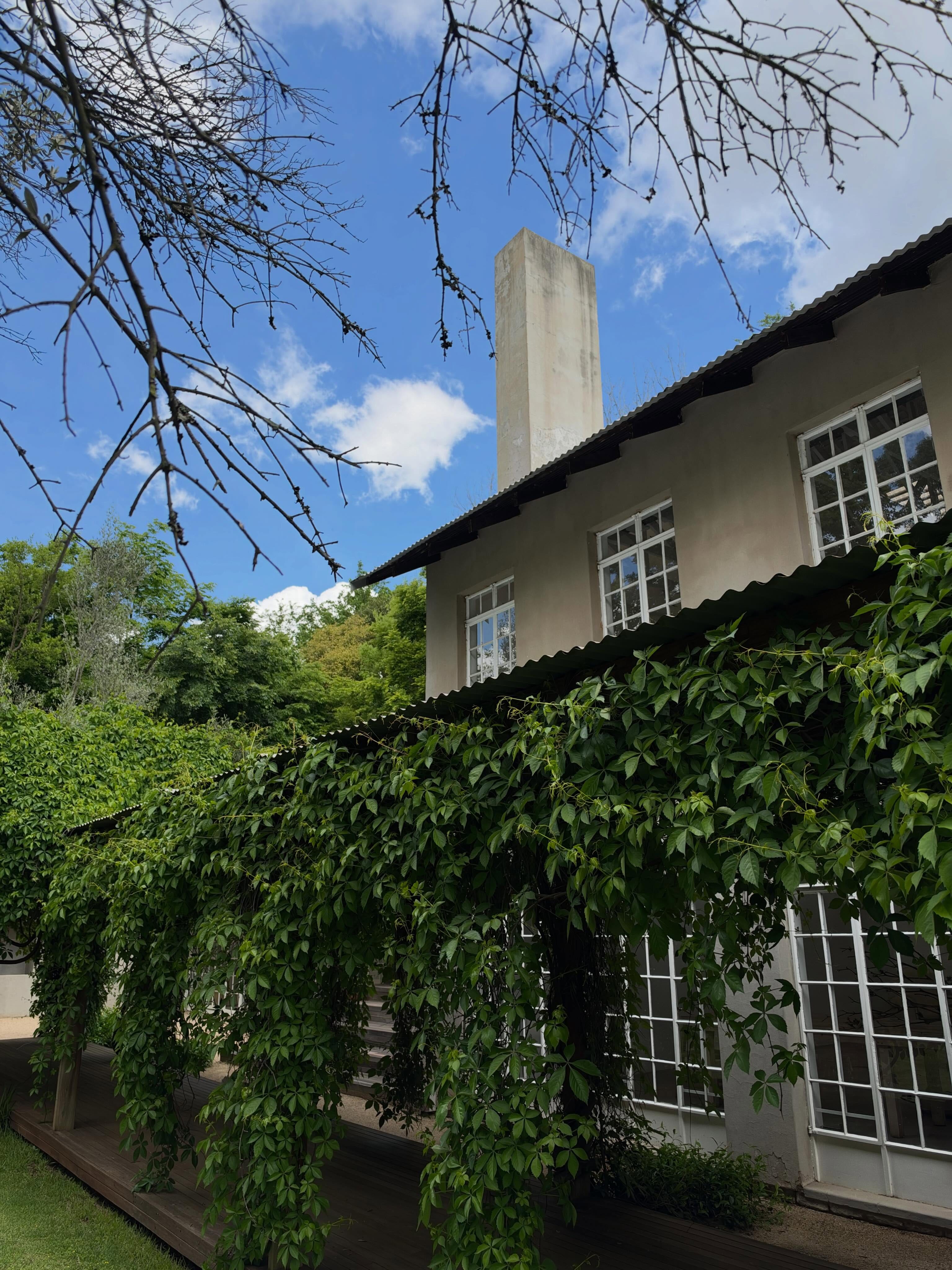
In October 2026, I spent some days writing at NIROX Sculpture Park, located in the ‘Cradle of Humankind’, as a guest of the NIROX Foundation’s Artist Residency, which has partnered with the Yvonne Mokgoro Foundation. A short drive away, the Sterkfontein caves hold some of the oldest evidence of human evolution, evincing the many who have delved into our existence on this planet.
I was invited to engage with the ‘Reimagining Democracy’ exhibition, which opened there on 19 September.
In August, nine illustrators and graphic designers were given 48 hours to respond to a question: what might democracy look like from here on into the twenty-first century? This was the Johannesburg leg; the same brief went to more than a hundred artists in Cairo, Athens, Sofia, Goa, São Paulo, Ramallah, London, Istanbul and Manila. The organisers acknowledged that in some contexts democracy can be “a dirty word”, its processes “tainted, weaponised, misused”, and so the task was not to illustrate democracy as it is, but to imagine “what it could become”.
The programme was conceived by Fine Acts and One World or None (OWoN), which describes itself as a cultural initiative working to actualise citizens’ assemblies and other forms of deliberative democracy. Its organising conviction is stated plainly on its website: “Systems don’t change until stories do.” The idea is that people will not ask for what they cannot picture, and that the work of picturing belongs to artists as much as to policy-makers.
I was asked to write about the exhibition. My ideas were further shaped by Ithateng Mokgoro of the Yvonne Mokgoro Foundation, and Benji Liebmann of NIROX. Fellow artist-in-residence Divleena Singh informed me about the Indian caste system that persists culturally despite progressive Indian constitutionalism, through which the inequalities of South Africa are better understood. In these conversations we acknowledged that South Africa is a far better place than it was under apartheid, and that the Constitution has been the instrument of real change. That should not be discounted. It is equally common cause that much remains undone. Yet our conversations kept drifting elsewhere: to artificial intelligence and to a changing climate, and to the sense that the world is about to change a great deal.


How can the rule of law hold in a period that is marked by its weakening? And by the increasing absence of ‘justice’? It is hard to look at the present without noticing how much of what we assumed to be settled is coming loose. The rules-based international order, imperfect as it always was, has drifted towards partisan interest and ethnic mobilisation, towards closing rather than opening. At home and abroad, anti-constitutional rhetoric has become prevalent. The Constitution is blamed for the failures of those who govern under it, as if the document, rather than the conduct it was meant to regulate, were the problem.
Part of the difficulty lies in language and ideas. The idiom of human rights that carried South Africa through the transition was built, in large part, to name visible wrongs. There was a pass, a statute, a sign on a bench, an official who could be identified and a law that could be struck down. That grammar of liberation still has its place, and there is still plenty of black-and-white discrimination for it to deal with. But the forces now shaping our lives are more abstract, more grey. They work through systems that decide what millions of people see and come to believe, through models trained on the words of everyone and owned by very few, through markets that move capital and attention faster than the legislature and courts can respond to, all on a warming planet marked by ecological decline. Control and manipulation of this kind is not announced as discrimination. It is harder to locate, and harder to prosecute as a clear wrong.
If constitutional democracy is to remain a binding force as the social fabric frays, its ‘grammar’ has to evolve. It cannot compete with the speed at which the world is changing if we don’t come to understand the rule of law differently. This difference means reading it, arguing over it and living it in ways that establish new kinds of harm, but also and more importantly, a fundamental understanding of our global kinship and the utmost value thereof.
Section 39(2) asks every court, when it interprets legislation or develops the common law, to promote “the spirit, purport and objects of the Bill of Rights”. It is worth noticing that the drafters chose the word spirit.
The spirit the Yvonne Mokgoro Foundation proceeds to advance is ubuntu. “Law in the spirit of ubuntu” is how it sums up its reason for being, and the phrase describes Justice Yvonne Mokgoro’s jurisprudential legacy. The first Black woman appointed to the Constitutional Court, she did as much as anyone to carry ubuntu from the postamble of the interim Constitution, which spoke of “a need for ubuntu but not for victimisation”, into the working jurisprudence of the Court. In S v Makwanyane, the 1995 landmark judgment that abolished the death penalty, her concurring judgment treated ubuntu not as a sentimental gesture but as a value that gives content to human dignity and to the respect owed to every person, including the worst offender. About a decade later, in Dikoko v Mokhatla, she drew on its restorative logic in the law of defamation, where the aim should be “knit together shattered relationships in the community and encourage across-the-board respect for the basic norms of human and social inter-dependence”.[1]
This is of relevance in a society marked by the bond-dissolving effects of consumerist capitalism. It is a turn to the soul of the constituted society, as it finds expression in our constitutional jurisprudence, in this country interconnected with all others.
Ubuntu’s familiar, human face is rendered through umuntu ngumuntu ngabantu: a person is a person through other persons. But it can also be read more broadly, as a metaphysical statement about interconnectedness in totality, a connectedness the sciences describe in their own terms, from ecology to quantum physics, and that many spiritual traditions have long recognised.
I suggest that moving from an engineered apart-ness (apartheid) naturally leads us to interconnectedness.
And further, quite logically, the circle of connection does not close at the human. Our concerns should equally include the river, and the leopard, and those not yet born. And if we accept that the purpose of a life, or of a society, is not the endless pursuit of profit and material growth in service of an insatiable ego, then ubuntu points somewhere quite practical. It points to care, for ourselves and for others, and to the habit of asking of every exercise of power and privilege: why, and for whom?
This is roughly what the nine banners of the exhibition speaks of, each in its own way.


Naledi Modupi’s Written in the stars, shaped by the people shows five young people gazing up at a blue sky in which words have been joined like constellations. Her point is that the stars already exist, but the lines between them, and the stories we build around them, are ours to draw, and (constitutional) democracy is like that, never simply handed down, always shaped by those who take part. Hust Wilson makes a related argument in type. His Democracy is not one powerful voice spells out the word ‘WE’ from dozens of individual faces, and again with elements of interconnected constellations, each distinct but part of the whole. Johnny Allison’s Together we spark the change shows two women, an elder and a younger, each formed from many birds, meet in a burst of light; his note insists that in coming together individuality does not disappear but transforms into something much greater than the sum of its parts.
Two of the works turn to the tree, our constitutional symbol. Apollo’s Rooted in each other mirrors a single portrait on either side of a trunk whose roots spread out beneath both faces, a way of saying that within a democracy we are equal because we stem from the same ground. Lisolomzi Pikoli’s One living democracy shows two faces merging into one, adults and schoolchildren, an elephant, a giraffe, a city folded into a landscape, and a leopard sprawled asleep along a branch. He frames it around the interconnection of all living things, the natural and the built world alike, and asks how growing democracies might be sustained through ubuntu and reciprocity. It frames ubuntu as an ecological concern.

Others insist on the material conditions without which talk of democracy rings hollow. Rendani Nemakhavhani, who works as PR$DNT HONEY, shows a woman carrying an enormous fish on her head beneath a sun, the whole framed like a postage stamp above the words We thrive by sharing; before we define democracy, she writes, we must first meet our most basic need, which is nourishment. Indeed, as my undergrad jurisprudence professor used to say, one cannot eat the Constitution. Ndumiso Nyoni’s Solidarity is on the cards draws a man and a woman as a mirrored playing card, each pouring from a calabash into the other’s, so that neither sits above the other and whatever is given is also received.
And two look into the future. Wes Leal’s Lead the way together is a cheerful cartoon of a small group of figures, one of them shining a torch whose beam spells out TOGETHER. It belongs to a series following characters as they rebuild the future through ubuntu, and Leal’s conviction that serious things can be said playfully for better reach. Musonda Kabwe’s Alien voter is the strangest of the nine and, for my purposes, the most provocative. It is the year 3000, aliens can vote, and a galactic confederation has agreed after centuries of (xenophobic) war that home is where one is, not where one comes from. The banner shows the inked thumb South Africans photograph and share after voting, raised by a figure drawn in a few green lines who is plainly not all that human.
Kabwe, Zambian-born and Johannesburg-based, is joking and not joking. The Preamble already declares that South Africa belongs to all who live in it, and his alien is, in one sense, simply that promise followed to its end. But the banner also asks a question more pressing by the day: who, or what, falls within the circle of the Constitution’s concern, and on what terms? We are building systems that speak in our voices and act at our direction, and we have not yet worked out what we owe them, or, more urgently, what they may be permitted to do to us. A constitution read in the spirit of ubuntu would take the second question first. It would insist that human and machine activity alike be regulated so that the conditions favourable to life, and to a good life, are not lost along the way. Section 24 already guarantees an environment protected “for the benefit of present and future generations”. That phrase may yet turn out to be one of the most important in the Constitution.
It would be easy to dismiss all of this as decoration, the kind of thing people turn to once the real work is done. Having spent years as curator of the Constitutional Court Art Collection, I know that symbols influence profoundly on our shared psyche, including on how the law is understood and practised. The collection began because Justice Mokgoro and Justice Albie Sachs, among others, understood that a court founded on diverse and progressive values ought to look like it, and that art could carry the Constitution’s promise to people who would never read a judgment. The Court’s own emblem is a group of people gathered beneath a tree. It pictures justice as a meeting of community rather than a decree, and it remains the clearest image we have of law in the spirit of ubuntu.
Art matters because it persuades differently than law. The defence of the Constitution has too often become reactive: a political rebuttal, and, at worst, a reach for the kind of force that silences dissent in favour of some prevailing ideology. Some of that is unavoidable. But a constitutional culture that only ever defends itself will become an energetic force that closes instead of opening up new ways of being. What the banners at NIROX attempt, and what is needed, is something else. We should be occupied with making the constitutional idea attractive, to show us what we look like when we come together, so that the case is made by inspiration rather than by force. This is not a nicety for those who can afford leisure. It is a way of tending the bond between us: culturally, spiritually, jurisprudentially.
Law has a spiritual dimension, and we should not shy away from it. We shape society, in large part, through words. We give it form by spelling things out, and it is no accident that a spell is also an incantation. Courtrooms are places of performance, with their robes, rituals, and forms of address, and the performance matters because it is how a society enacts what it holds sacred. A constitution treated as a mere instrument, to be bent whenever it becomes inconvenient, loses its binding power. One treated with something like reverence holds.


This is not to make constitutionalism a religion. We do not follow it because it is above reproach; it isn’t, it is a human tool, and those who apply it certainly aren’t neutral in using it. We follow it because history has shown, again and again, what happens when societies wander from the rule of law towards the rule of terror. The supremacy of a moral and just document, however imperfectly applied, is better than rule by partisan and tainted politicians, dictators, and shareholders. South Africans know this from our history, and what we have done to advance an interconnected constitutionalism may be our particular contribution to a fracturing world. Constitutional culture is what binds South Africans and all who live within our borders, more so than a braai or rugby, across differences that would otherwise violently pull us apart.
Which brings me back to the young people in Modupi’s banner, looking up. The Constitution was written by elders, many of them now gone or deemed tainted. But we should keep faith with our constitutional values. This is an active act of rejuvenation. Every generation has to renew the Constitution for its own epoch, to add to the story rather than live inside the old one. The generation that drafted it faced the task of forging a single nation from a divided people. Ours faces the task of keeping that country, and in some sense the human project itself, intact through a technological and environmental upheaval that nobody at the negotiating table in the early 1990s could really have imagined. If we do not do that work, we risk losing our footing, as a nation and as a global community.
If we cannot recognise our oneness, we will meet whatever rupture is coming divided, and our chances of reaching the other side intact, let alone better, will be far smaller. Ubuntu is a moral core to hold on to, to work from. It asks us to stay rooted, to borrow Apollo’s phrase, in each other, and to hold on to the Constitution as something to be tended and embodied rather than merely invoked, so that we are not swept away by the many forces that would distract us from what actually matters. Put simply, it asks us to live in love. That sounds soft, and not like the law of a court. But it is true. Yvonne Mokgoro would likely have agreed.


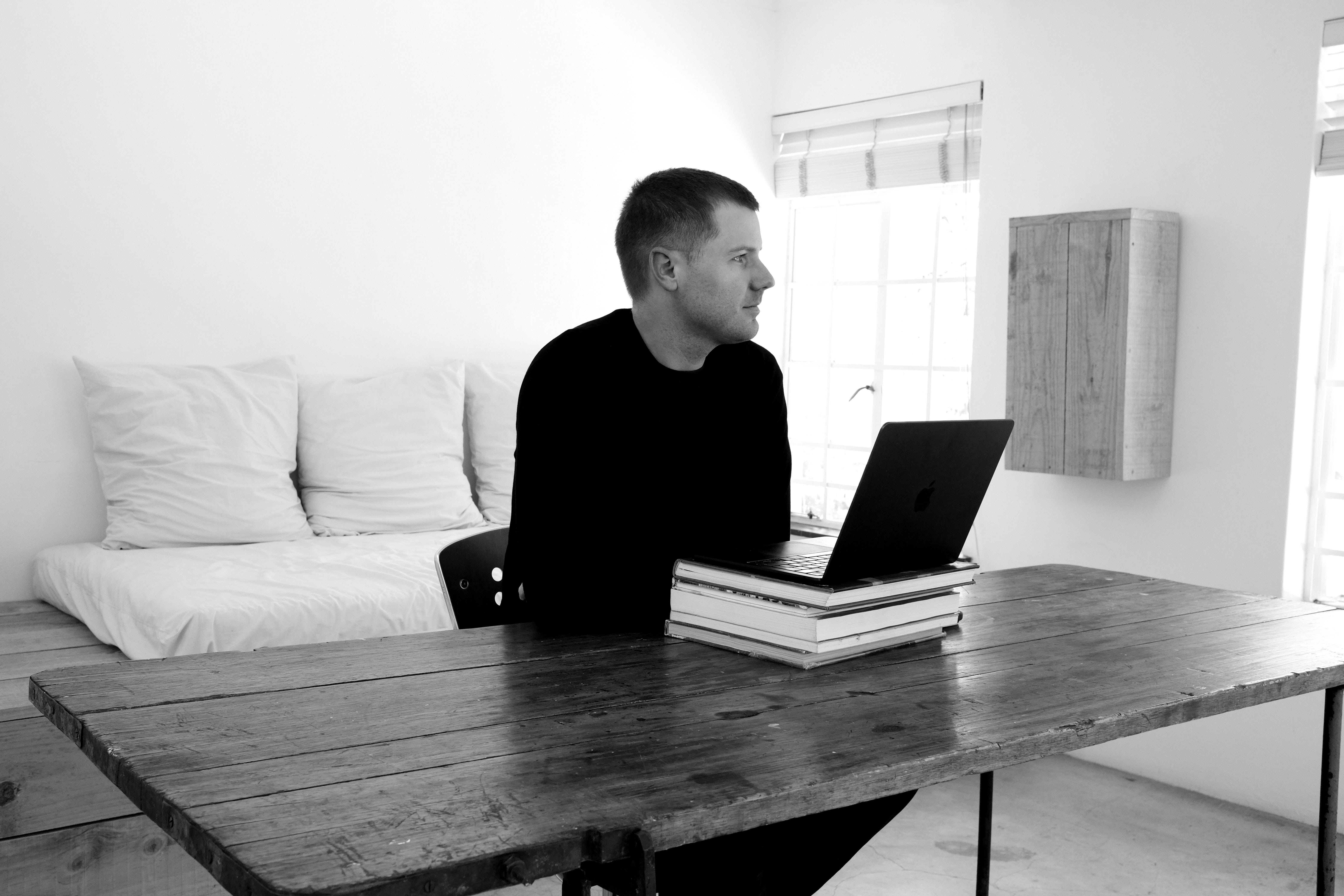
Dr Francois Lion-Cachet is an advocate at the Johannesburg Bar and former curator of the Constitutional Court Art Collection. His research and writing explore law, culture, and constitutionalism. He was a writer-in-residence at the NIROX Foundation in October 2026, as a guest of the Yvonne Mokgoro Foundation.
[1] Para 69.